
“Everything that happens to us now, we appreciate.” Shed Seven Interview at Y Not Festival
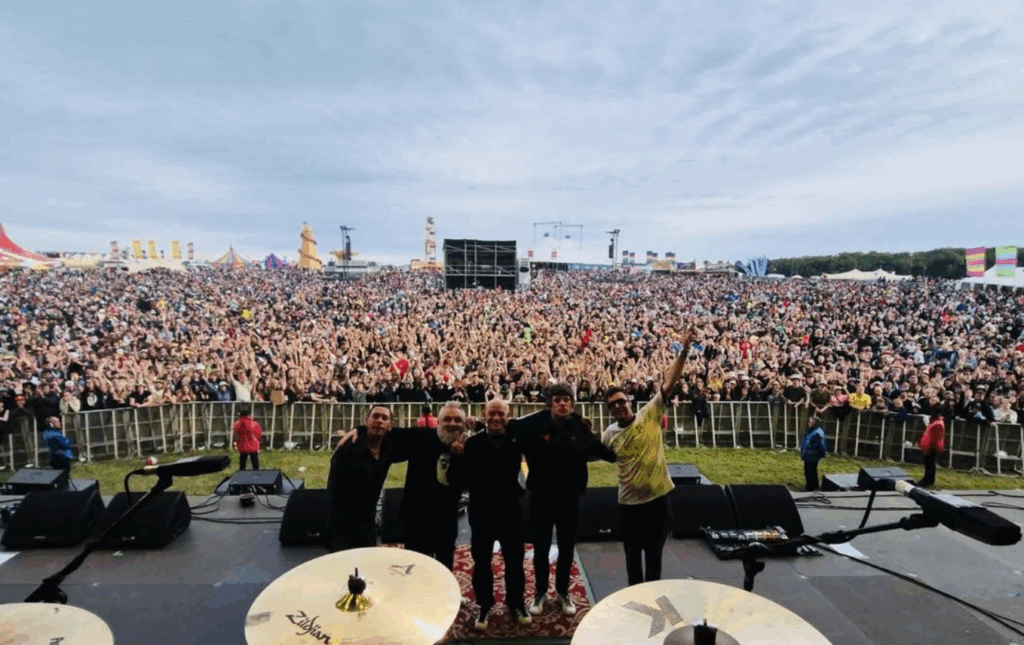
Image Credit: @shedsevenofficial on Instagram
Walking into Shed Seven frontman Rick Witter’s dressing room, the nerves were strong. This is a band I’ve listened to for years, and here I am interviewing their lead singer in person. “Welcome to my office”, he jokes, smiling through a pair of sepia-toned sunglasses and creating a much more casual environment for the interview to take place. Looking around, there are empty coffee cups, with Witter admitting that he’s tired from staying up too late after a gig the night before. He’s very keen to play Y Not, however. Of course, playing the main stage grants the most energy to a performer, so we settle down to start the interview.
Gabe: You’ve mentioned in the past that your recent songwriting and music has taken you back to when you were much younger, closer to that Chasing Rainbows era. How do you marry the fact that you are older now with that youthful sound that you’ve recaptured?
Rick Witter: Well, I think we (the band) feel like we’ve been given a second lease on life, and I think that’s kind of tipped into the songwriting subconsciously. To be fair, when we said that about going back to our youth, me and Paul (Shed Seven’s lead guitarist) started writing songs together when we were 11. So we’re kind of, without overthinking it, we were just reminiscing about being young boys, sat in each other’s bedrooms, listening to Duran Duran and Simple Minds and U2. Because we were 30 years old last year as a recording artist band, it’s a big anniversary for us, so we felt we wanted to dip into our youth, so to speak. But to be fair, we don’t overthink things, we don’t plan things, you know? We just do it, and what happens, happens. It’s like we’ll write a set of songs and then when we’ve completed that, we’ll decide what we think is worthy to be a single, what’s worthy to be an added track on an EP. It’s really great how we can be 52 years old and still feel 15.
Gabe: The past couple of years have been somewhat of a renaissance for the band. How do you keep that motivation to not only consistently perform at festivals and gigs but also to put out new music?
Rick Witter: We don’t know how to do anything else. We’ve been doing it that long. And people do say a renaissance, but to be fair, we’ve built this up over the past maybe 10 years. We’ve been consistently touring, adding to our fanbase. We’re very good at playing live, so we’ve got a reputation now. People come and buy tickets to come and see us because hopefully they’re gonna get a good gig, and that just bleeds into rehearsals, and that bleeds into you just writing new stuff. Paul will just be mucking about on his guitar in a rehearsal coming up with this riff and I’ll say ‘What’s that?’ and he’ll say ‘I don’t know I’m just doing it’ and before you know it I’m on my hands and knees with a notepad scribbling down lyrics you know, and something that didn’t exist 20 minutes ago is just there in the room with you. And it is really weird, some songs we write it is literally like you’re just plucking it out the sky. Most of our biggest songs, weirdly, I don’t feel like we did it, but we did, it’s nobody else’s!
Gabe: Speaking of nobody else’s, you put out a covers EP this year. What was the thinking behind that, and why did you choose the songs that you did?
Rick Witter: Well, for the sake of trying to get album sales, we did it as an extra bonus thing, to the trickery of that, but then equally, going back to thinking about bands from our youth, a lot of them songs were what we were listening to, so it kind of all tied together really well. It wasn’t just a marketing ploy; it was a little bit of love in there as well. Everyone needs a little bit of love.
Gabe: On top of the covers EP, you also put out a Live Album of Liquid Gold, your band’s revisitation of older music. How did it feel to record that at the York Museum Gardens?
Rick Witter: That was amazing cause it’s our home town, and we were always very conscious of over-playing our home town cause that’s what so many bands before they’ve got a record deal would do. They’d play in the same pubs every week, and we always kind of steered clear of that because it becomes very boring, so we always tried to make playing our home town an event. So, thirty years later, a big anniversary year, it was only right that we did something in our home city. It was in a place called the Museum Garden, which is where we used to hang around when we were kids. We’d get our blasters on our shoulders, listening to music. I believe the last gig they put on in that place was Roxy Music in the very early 1970s, so everything just worked so well. It was an unusual place to play. Even the love of realising that so many people descended upon our home city and were using the taxis and the hotels and the restaurants, it was amazing. Everyone won.
Gabe: You said you’ve been around for over 30 years now. In your wildest dreams, did you think that you’d still be doing what you’re doing, and how does it feel to know that you’ve still got fans showing up in droves to see you perform at festivals like Y Not and gigs?
Rick Witter: So, we’ve realised, like any life, and if you’ve been doing it for so long, there are massive ups and downs. Being in a band is like being married just to four other blokes. You go through so many ups and downs. We were quite big in the 90s, then in the noughties it kind of died a little bit of a death, but we were very canny, so we thought we’d stop for a bit rather than just flog a dead horse. So giving it a four-year break helped a lot, and when we eventually came back just to play live gigs because that’s what we liked to do, we noticed a big surge in tickets. At that point, we realised what we’d done in the 90s actually meant something to people, cause when we were doing it in the 90s, we had no idea it was connecting with people, and obviously we were going in the charts and stuff, but for the songs to still kind of live there and work so many years later is an amazing experience. So to answer your question, everything that happens to us now we appreciate it, we remember it, it’s stored away, and we don’t take any of it for granted because who knows how long these things last. We’re very lucky in the sense that we’re still here doing it because it’s something that we love doing, and there aren’t many people who can say that their job is ace, you know? We’re very lucky for that, so as long as we don’t get cancelled for something, we’ll still be here in a few years.
Written by Gabe Morrissey-Limb