
A Review of Symbolism in Handel’s ‘Susanna’: A Production by Opera North
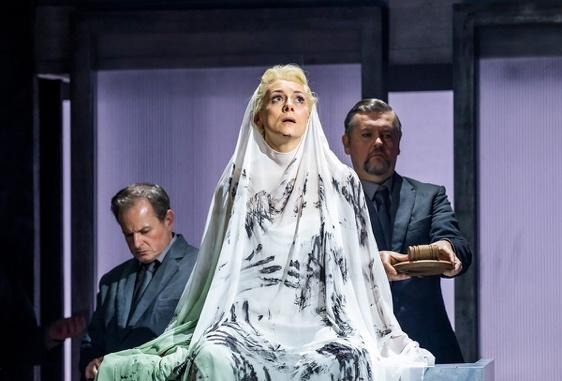
Image Credit: Tristram Kenton
Lisa Clark reviews the use of symbolism in Handel’s ‘Susanna’, a production put on by Opera North.
Handel’s opera ‘Susanna’ follows the story of a young woman’s battle with the public eye and gender-based scrutiny, as a victim of two predatory men who are out to destroy her reputation. This emotionally driven Opera North production casts a powerful gaze on a continued power struggle and challenges the constructs built around violence against women. This touring production, directed by Olivia Fuchs, most brutally portrays the struggle through the musical and physical symbolism brought to the stage.
This story was portrayed with an impressively simplistic set, which was essentially created with just 6 boards. What I found most compelling about this production was the use of dancers (Phoenix Dance Theatre) as both props, and as an emotive lens. Yasmina Patel entranced the audience in Act II, with her portrayal of water in the bath, in which she represented both Susanna’s temperamental emotions of her husband’s departure, and the physical warmth surrounding her in the bathtub as the ‘water’ encased her. Could this have also been a foreshadowing of the true entrapment she was about to feel, which was not so comforting? Patel later, alongside Teige Bisnought, conveyed the devastating separation of man and wife, and the hesitance that comes with it.
Another subtle detail of this opera which held great impact was that Susanna (portrayed by Anna Dennis) rarely sang directly to the audience. However, when she did, it was out of fear, with examples being during the assault itself and her public execution. Both of these evoked severe levels of sympathy for her, as she represented all the women throughout history who have cried out to anyone who will listen. This took a transition for the final Act, as Susanna begins to use her voice as a weapon, confronting those who did her wrong, and taking centre stage to tell her own story.
Whilst this was a rapid transition spatially for our central figure, the changes occurred gradually through costume. In Act I, Susanna is seen in her wedding outfit, consisting of trousers, long sleeves, and boots which cover her skin entirely, maintaining her innocence and purity as a character. However, by Act II, she is found in her most vulnerable state, with her arms and legs exposed. She is left with only a white shawl to contain herself, which becomes the physical symbol of her dignity, as the two elders do everything in their power to take it from her. She holds onto it desperately.
In a full circle moment, Act III presents Susanna in a full robe, which entirely conceals her. This felt the most symbolic to me, as whilst she outwardly seems most defenceless in Act II, Act III is where she faces true helplessness, in the face of death. Whilst her ghostly and angelic appearance is, on face value, a reference to her proximity to death, it is a true representation of the innocence the elders have ripped from her. The contrast between the handprints on her body, and lack of freedom of her own hands, undoubtedly discusses the restraints and expectations placed on a woman’s body.
This production perfectly epitomized the entrapment of the female voice. From the waves of emotions physically seen on stage, to the symbolic costume and colour theory, Anna Dennis and Opera North have passionately captured the unrelenting gender struggle. This timeless piece enraptured the audience, in what remains a deeply relevant topic.
Words by Lisa Clark
Image Credit: Tristram Kenton