
Synthpop is Back! Nation of Language at the O2 Ritz
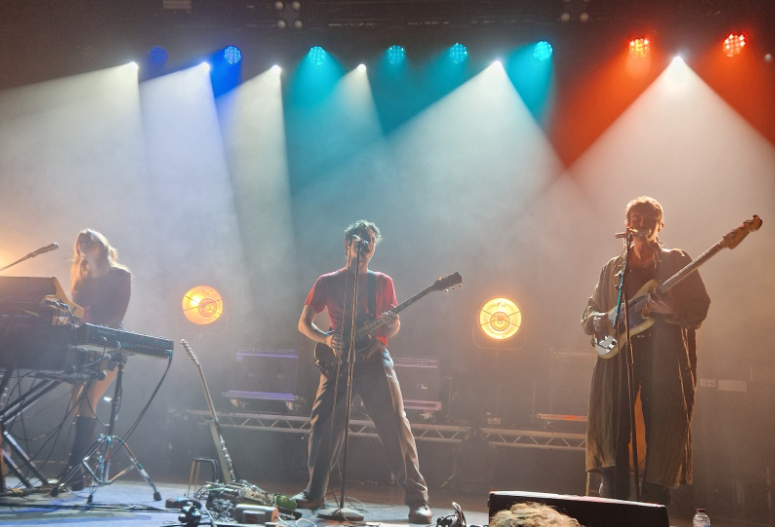
Image Credit: Rowan Morrow
It’s hard to ‘revive’ a genre once the big wave has gone. Bands risk coming across as empty nostalgia bait, retaining some of the sound but none of the soul. But that’s not the case for Nation of Language, who are bringing pure 80s synthpop to the 2020s – and making it sound really, really good.
This is not the synthpop of Lycra and kitsch; it’s suave, intense dance music. There’s an obvious late 70s Kraftwerk influence, with a little New Order, plus the kind of mournful, searching lyrics that would sound completely at home on a Pet Shop Boys or Bronski Beat record. Of course some of those 80s synthpop legends are still playing now, but I generally have quite a firm stance against spending a fortune on a stadium gig just to watch a group who looked and sounded better twenty years ago. Whereas Nation of Language are young, good-looking and just getting started.
I’m here to see them at the O2 Ritz in Manchester. It’s very easy to get to from Leeds (just across the road from the Manchester Oxford Road station), so I’ve managed to arrive much too early. At least I’m near the front. The crowd skews very middle-aged – people who want to relive the 80s, or more of a reflection on which demographics can actually afford gig tickets these days? – so I have to suffer a torturous wait for the opener, surrounded by blinding screens scrolling Facebook and sickening PDA from elderly couples. It’s a little saddening to think that this kind of 80s synthpop might be written off nowadays as ‘dad music’, when in fact I think it could bridge a gap in the current UK club scene. Usually you have to make a choice between ‘interesting dance beat with some care and attention behind it’ or ‘lyrics you can sing along to’ – but synthpop could give us both!
Westerman, the opener, is melodically mesmerising, if quite low-key. There’s something of early Foals and even a little of Leeds’ own Alt-J in his looping acoustic sound. Unfortunately, it’s like I’m watching him through thick fog. Even though he’s mere metres from my face, the gratuitous smoke machine plus a harsh backlit spotlight makes it hard to get a sense of what he’s wearing, or what he might look like. ‘I can’t see in this much glorious light,’ he sings, ironically, on new track ‘Nature of a Language’. Westerman has a precise, deliciously textured voice, and these reverberating guitars sound lovely… but the performance doesn’t provide much visual thrill, and there’s a sense the crowd are losing interest.
In stark contrast, Nation of Language frontman Ian Devaney is full of beans. He leaps and lunges across the stage, swinging his microphone stand with wild abandon, bobbing backwards and forwards between the other band members – Aidan Novell on synthesisers, and Alex MacKay on bass. Although there’s perhaps a shyness in the way Novell hides behind the towering synth deck, she’s smiling throughout. MacKay has a more serious vibe, but this is easily counterbalanced by his brilliant hair (whimsical pigtails) and the fascinating necklace-mounted harmonica contraption that he wears for the first song.
It doesn’t take them long to get the crowd moving – they’ve got plenty of big dance tracks, and even the least danceable Nation of Language song is still quite danceable by most standards. Hearing the big choruses on songs like ‘September Again’, ‘Wounds of Love’ and ‘Inept Apollo’ is a treat live. ‘Silhouette’, from their newest album Dance Called Memory (2025) gets a more full-bodied mix live, compared to its relatively downtempo place on the album. There’s still room for a quieter moment, though: when the lights drop down for ‘Weak In Your Light’, the crowd feels like they’re holding their breath.
Hearing this many Nation of Language songs together – and they’re not just playing the new stuff, with a setlist spanning an even mix across all four of their albums – really makes me appreciate how cohesive they are as a band. Without feeling too samey, there’s definitely a signature sound here. The synths are pulsing and decisive. The guitars are well balanced. Devaney’s vocals are crystal clear despite all the leaping around.
I’m struck by Devaney’s lyricism, too. Although many of these tracks are ostensibly love songs, it’s a vulnerable, precarious impression of being in love, with the lyrics circulating back to repeated themes – waiting, watching, feeling uncertain, wanting. I can’t help but find some queer resonance here. But there’s also a sense that this is an expression of youth, of not yet knowing your place in the world. Devaney’s boyish vulnerability – he looks out as if he’s really searching for something in the crowd – cuts right to the heart.
They leave the stage without playing my favourite track, ‘On Division St’. Disaster! But, of course, they’re back for a big encore. I’m nervous when they start playing a track that I don’t know – this would be a disappointing ending for such a good set – but I needn’t have worried, since they drop into ‘On Division St’ immediately after. The crowd are nearly drowning out the band, bellowing out the mournful chorus, ‘I would like to find the answers I was always rudely denied.’ Then another song – ‘Across That Fine Line’, also an intense, searching hit. The crowd are loving it.
I think it’s finally over. Rapturous applause. ‘This is gonna go to my head,’ Devaney says bashfully, in his adorable New Jersey accent. The band strikes up with one last thunderous chorus – then it’s over for real. I’m spat out onto the chilly Manchester street to make my way back to the station, feeling warmed.
Words by Rowan Morrow.