
Milk vs Money: The cost of the longest U.S. government shutdown on 42 million SNAP recipients
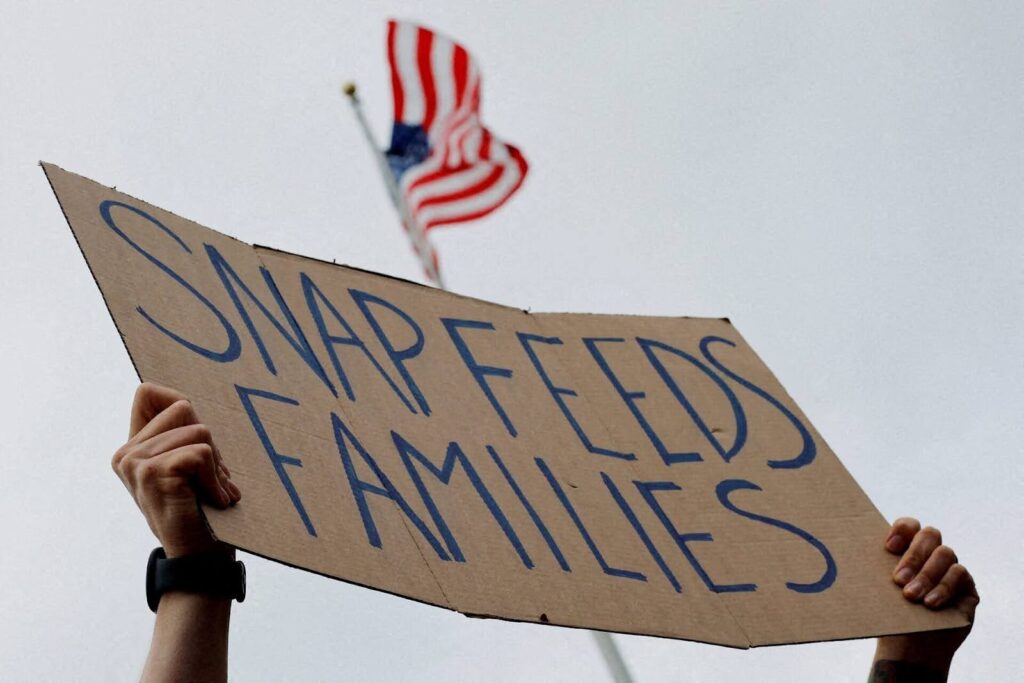
Image credit: Reuters
Everyone will remember the headlines about the longest government shutdown in U.S. history, fewer will remember the empty fridges and dinner tables it left behind.
42 million Americans faced decisions no one should have to make. Freya Gillette was forced to choose between diapers and food for her two‑year‑old son. “It breaks my heart, and stresses me beyond my limits,” she told TIME. Kat Bogdon, another Supplemental Nutrition Assistance Program (SNAP) recipient, said: “Daily things that are normal feel like luxuries.” For people like them, the shutdown was not just another political debate in Washington; its impact was felt through impossible choices and anxiety over basic human rights like meals.
Before the financial year ended on September 30, 2025, Congress failed to pass a budget, triggering a government shutdown, the first since 2019. Dispute over funding led to a stalemate. Democrats insisted on protecting healthcare subsidies and social programs, while Republicans rallied for spending cuts. The 43-day shutdown from October through November became the longest in U.S. history. The impact was immediate: 1.4 million federal employees went unpaid for weeks, thousands of flights were disrupted, and SNAP benefits for 42 million Americans were suspended.
Outside those pristine marble halls of Capitol Hill, the debate was measured in milk and bread, in diapers and dinners. Parents skipped meals so their children could eat. For 42 million Americans, SNAP was not a convenience but a lifeline.
Ellen Mei, a USDA program specialist, was fired after she told PEOPLE she was “anxious because we’re hearing about the risk potentials and office closures that are looming over USDA as this shutdown kind of drags on,” warning of the impact on SNAP recipients. In Pittsburgh, grocery store owner Ryan Sprankle stated bluntly: “You can’t take away from the most needy people in the country. It’s inhumane.” Food banks reported demand surging by as much as 1,800%, with volunteers identifying queues that stretched down streets and families arriving in tears. Human Rights Watch stated: “Continued failures by the US government to adequately fund food assistance forced families into difficult decisions to make ends meet and posed serious threats to the human rights of tens of millions of people.”
As the shutdown dragged on, the fairness of SNAP became impossible to ignore. Those opposing it argued that the program encourages dependency and suggested that food aid should be limited to promote self-reliance and provided only to those who need it most. The Heritage Foundation warned that “one in eight Americans rely on the federal government for food assistance,” calling it proof of SNAP’s “failure to promote upward mobility.” Meanwhile, defenders of SNAP argued that it is a basic human right and an essential safety net demanding dignity over austerity. On social media, thousands rallied to support families whose struggles suddenly became a public predicament. For most, the debate was less about figures and more about survival, with supporters emphasising the moral obligation to aid those in need.
The shockwaves of the US SNAP crisis sparked reflection globally. In the UK, food insecurity has skyrocketed. The Trussell Trust reported distributing 2.9 million emergency food parcels in a year, a 51% rise in five years. Campaigns like the Food Foundation’s Feed the Future pushed to expand free school meals to all children on Universal Credit, warning that hunger sabotages education. Research showed that most people who claimed Universal Credit went without meals for days. Just as families relying on SNAP benefits in the U.S. struggled to make ends meet, British households are facing similar choices, a reminder that food insecurity is not confined to the US but is a shared challenge for communities across the UK and globally.
Ultimately, the debate over food aid goes beyond mere figures and spreadsheets. In both Washington and Westminster, it exposes the instability faced by millions. Food insecurity is not an isolated problem, it is a shared vulnerability.
One must argue that welfare systems are not abstract policy tools but lifelines, and when misgoverned, the impact on the quality of human life is immediate and quite substantial. What began as a political deadlock became a shocking reminder that the fairness of food aid is ultimately measured not in numbers or budgets, but in the meals that reach a child’s plate.
The shutdown may be over, but the important question still remains: Is food a human right or just another numerical bargaining chip?
Words by Jeshna Arya