
Skinniness for Sale
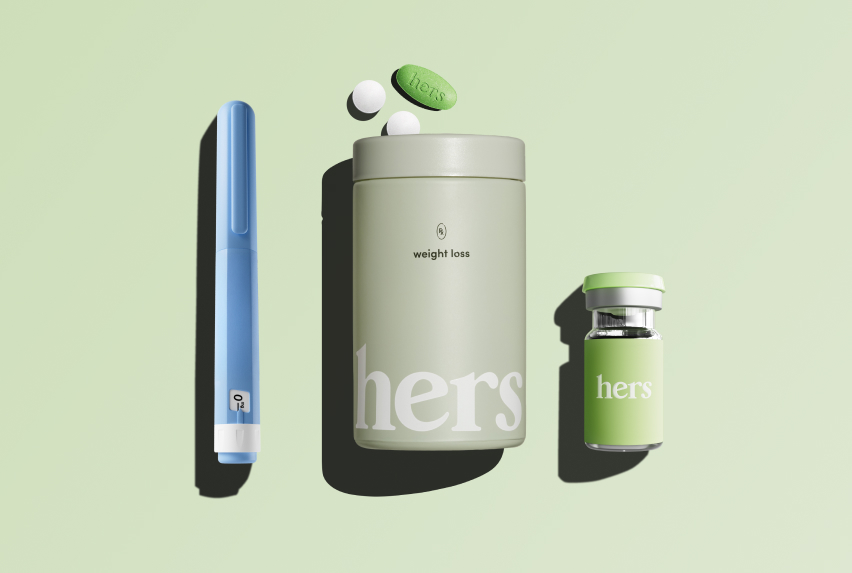
Image credit: Hers
“Hi, my name is Lutifah Thomson-Lowe, I’m 39, I’ve been with Juniper for four months now, and I’ve lost 27.5 kilos”.
This Juniper weight loss advert, with various others like it and the occasional Numan campaign, were all I saw when I clicked on YouTube videos earlier this year. For months, I was bombarded with before-and-after thinspiration images, testimonies of how much weight these women had lost, and reasons why you shouldn’t be ashamed to try weight loss medication. In the height of January’s exam period, I’d go on YouTube to decompress and take my mind off the looming pile of work. It worked, I was distracted. I was no longer thinking about my stance on Catalan nationalism or whether language was viewed through a nationalist lens in early modern Europe. Instead, I was thinking about how much I was eating, my weight, my body. No matter the creator or subject matter of the video, which were never gym, lifestyle, or diet focused, I was always forced to endure thirty seconds of weight loss promotion and my thoughts would loop back round to diet and what I was seeing in the mirror. I noticed my lunches get smaller and my appetite for sweet treats diminish.
After a while, the ads went away. As suddenly as they came. But their message of ‘weight loss at all costs’ didn’t leave me. I have not recovered my former status of sweet-tooth snacker.
Those ads weren’t made specifically for me. I wasn’t the only one who saw them and I wasn’t the only one who was relentlessly fed them.
Alice received several ads a day from a PT selling a package on YouTube.
“The ad was targeted at ‘women over 40’ if I recall correctly. There was an assumption that everyone must be worried about their weight at that age. It all felt like an enormous stereotype.”
“At first I just thought ‘who’s this young guy acting like he knows the concerns a woman in her 40s might have about weight’? Later I found it irritating.”
“However well-intentioned, the ad could undoubtedly make women feel bad about themselves, or as if they need to look or be a certain way”.
“That could be disastrous for people with eating disorders of course, especially seeing it repeated so frequently”.
Many took to X, formerly Twitter, to express their frustration and search for fellow complainants.
In April, Rue posted:
In a conversation with me, she admitted that she kept seeing “this semi-long ad about this woman who had been struggling to lose weight and finally did so through Juniper” on YouTube. Rue “used to be overweight,” then developed an eating disorder.
“I was diagnosed with atypical anorexia. I’ve been in recovery for a while now and have gained some weight in the process”.
“I was already struggling with body image issues so being blasted by the ad every time I opened YouTube this summer was super frustrating. It kept reminding me about my weight, about dieting, and about how this is the ideal”.
“I felt like because I was getting weight loss ads I must need to lose weight, even though logically I knew I wasn’t overweight”.
“The summer is usually quite hard because everyone is talking about their bodies and dieting. I found myself checking my body, being unsatisfied, and planning out my eating even more.”
I asked Rue if she took any action against the ads. She said she “tried to figure out if she could get the ad less,” but wasn’t sure if she succeeded.
On YouTube, there is no quick fix. In order to block all weight-related ads, the change needs to be made within the Google account.
Research conducted by Liza Gak, Seyi Oloji, and Niloufar Salehi at UC Berkeley has found that “online content which promotes the ‘thin ideal’, like weight loss ads, promote behaviours associated with eating disorders.” From their study, they concluded that “after seeing the ads, participants reported feeling frustration, annoyance, and disgust.” “It reinforced low-self esteem, a feeling of a lack of control, self-doubt, and helplessness.”
Weight-loss ads “reinforced depression and anxiety around food and self-control, encouraging cycles of binge-eating and calorie-counting”. Being delivered weight-loss ads was “emotionally and mentally draining.”
The online weight-loss campaign was still strong four months later, when Nova tweeted in August:

Nova said that “every single YouTube video had an ad for pills or injections”, but from Hers, rather than Juniper, and found that “all of the apps push weight loss ads”. She noticed “the ramp up around six months ago,” last Spring, but has been “seeing them for over a year at this point across multiple platforms.”
She said to me that, as she herself doesn’t have an eating disorder but has struggled with body dysmorphia, she “can’t imagine being bombarded by these kinds of ads while recovering from an eating disorder or actively experiencing one.”
“Seeing the ads constantly makes me feel really sad that such a huge part of society is so obsessed with not being fat/always trying to lose weight. I grew up seeing fatphobic content everywhere I turned and I feel like it’s coming back round again”.
“Everyone, even people who aren’t overweight, are getting their hands on Ozempic or something similar because God forbid we just treat our bodies as what they are: just our bodies, and not our whole selves.”
Nova, like others, has noticed that the body positivity movement, in its prime in the late 2010s, is well and truly over. Thin is back. It never went away completely, but from 2017 to 2020 there was acceptance and representation of larger bodies. Now, the space that was made has shrivelled up.
Refinery 29 has established that in the 2025 spring/summer season, just 0.8% of the models were plus sized, down from 2.8% in 2020. The number of plus-sized models dropped again this autumn/winter to a mere 0.3%, Vogue Business reports. 97.7% were between sizes 4-8, XXS-S.
It isn’t just fashion houses that are embracing thinness once more. The use of GLP-1s, more commonly known as Ozempic, has increased. Depending on the type of GLP-1, it can reduce body weight by 6-21%. In 2023, there were 20 million prescriptions for Ozempic in the US. In 2024, this increased to 1 in 8 adults, nearly half of whom used it for weight-loss. In the UK, according to BBC InDepth in September, 1.5 million people in the UK use weight-loss medications. 8.4% use them for ‘quick results’ and 21.2% heard of them from social media.
The intense campaigns of these weight-loss medication companies, Hers, Juniper, and Numan, are one symptom of society’s renewed obsession with thinness. This revert has led to anger, frustration, and disappointment. Plus-size model Stella Kittrell spoke to The Everygirl, “in hindsight”, the inclusivity efforts in fashion “seem performative.”
But, there are more sinister consequences. The constant promotions of weight-loss medications reinforce preoccupations with diet, weight, and body image and can impede the recovery of eating disorders, by stimulating related behaviours.
There needs to be a clearer way to block harmful ads online, on YouTube specifically. Not just that specific ad, that specific company, that specific time, but an easy, obvious option to block all related ads, which doesn’t involve going into your account settings. But, more importantly, social media companies need to prevent these advertising barrages from happening in the first place. At worst, incessantly seeing the same adverts (on personal issues such as weight) for months on end, on every video, is deeply damaging. At best, it’s just boring.
Words by Rosie Nowosielski