
The World’s Forgotten Wars – The Libyan Civil War
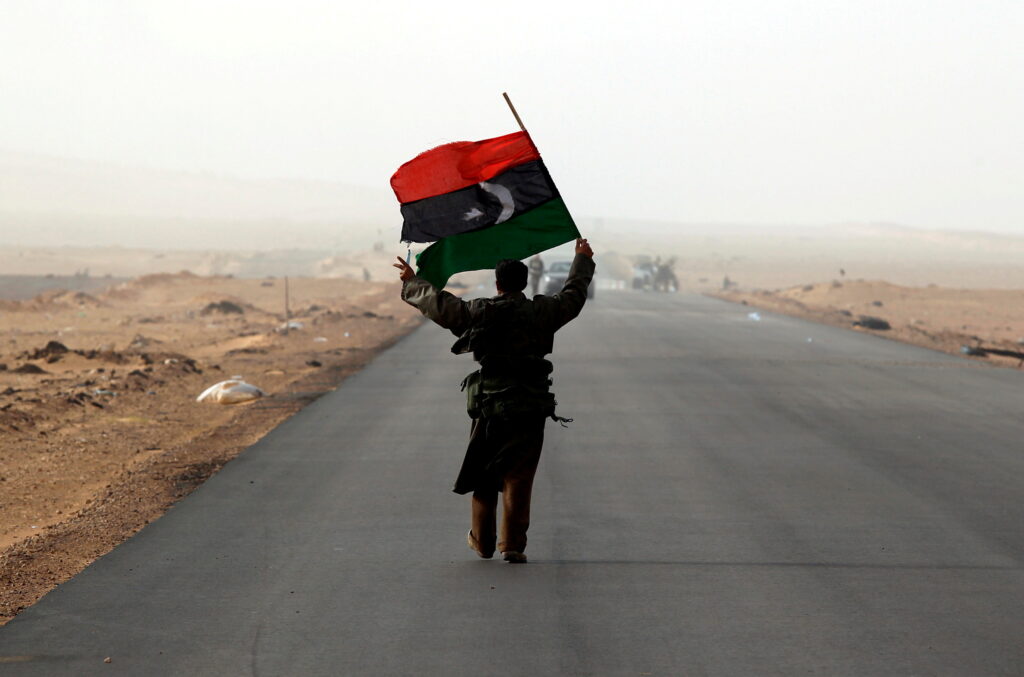
Image Credit: Reuters
Libya has been wrecked by chaos for almost 15 years. 2011 was a year that ended with hope, the long time dictator had been toppled and democracy was the dream. But today a long-running civil war persists, one that flares up and calms down over time.
2011 Arab Spring
The conflict in Libya can’t be understood without the Arab Spring.
Libya, like most Arab countries, saw mass protests against corruption, bad governance and repression in 2011. Before the Arab Spring Gaddafi had led the country for decades having come to power in a military coup against the monarchy, the governments he had led followed a range of ideologies from socialism, to Arab nationalism, to pan-Africanism and at one point a system where the state no longer existed (of course, this non-existent state was still led and controlled by Gaddafi). The only themes that linked these governments were oppression and Gaddafi.
Protests began in mid-January, primarily in the east around Benghazi, but were quickly fueled on the 16th of January with the arrest of a human rights activist. As seen in much of the rest of the region these protests were met with violence and led to more protests. The protests led to an increase in crackdowns and a vicious cycle of violence. By the 20th of February, the death toll had surpassed 230. From here protests increasingly met violence with violence, soon they would be bolstered by elements of the military who began to defect. By the 25th of February, armed groups began advancing on the capital, Tripoli.
What started out as protests was now descending into a full-scale civil war. In March, the rebels formed the Transitional National Council (the first of many, many Libyan governments). On the 18th of March, the UN imposed a no-fly zone in order to protect civilians and NATO began airstrikes against Gaddafi’s forces. These strikes would split the international community with NATO using them as an excuse to fully aid the rebels in overthrowing Gaddafi, a position fueled by Gaddafi’s brutality. However, Russia saw them as a method to stop the fighting, not a tool for regime change.
Between April and August, NATO stepped up its military aid to the rebels in a growing effort to force Gaddafi out of power. This aid slowly began to turn the tables and on the 26th of August, the rebels had entered Tripoli. By October, Gaddafi was captured, killed and the Transitional National Council was recognised as the UN government.
However, this would only be the beginning of a much greater cycle of violence.
2014 Civil War
The fall of Gaddafi should have signalled the start of a new path towards freedom in Libya.
To start with, there was hope. In 2012, a new government was formed, the General National Congress (government number two, do your best to keep up), following the country’s first ever truly free elections after rule by an autocratic king and then an autocratic colonel.
Yet, this government struggled to maintain control as Islamist forces fought against what was a largely secular government. The Islamist insurgents attacked a range of targets, including the infamous attack on the US embassy in Benghazi.
By 2014, the General National Congress (GNC) had run out of time to form a new constitution and was forced to hold new elections for the House of Representatives (HoR). These elections were heavily contested and saw Islamist elements that were elected to the new HoR break away. In response to this, General Khalifa Haftar (a former Gaddafi loyalist turned rebel defector) launched Operation Dignity against Islamists across Eastern Libya.
The outcome of this was the splitting of the country into two. In the West was the Islamist-led GNC and in the East, Haftar’s HoR (this was now the third post-revolution government).
In 2015, the United Nations attempted to bring the two fighting sides together under a newly formed Government of National Accord (government number four). Despite being the UN recognised government, it was unable to unify the East and West of the country and it effectively just became the successor government to the East ruling GNC.
The Civil War has continued since this new government was formed and effectively continues to this day. In 2020, the UN rebrockered another ceasefire between the two sides and formed the Government of National Unity, or GNU (government number five). This government was also tasked with the job of unifying the two sides. However, elections to this government were cancelled and negotiations collapsed. By 2021, the HoR withdrew to form the Government of National Stability, or GNS (Government number six).
Despite rounds of name changes, the situation is the same as it was in 2014. In the East is the GNC/GNA/GNU and in the West, Hafter/HoR/GNS.
Who’s backing who
The situation in Libya only becomes even more confusing once we add in the international actors supporting each side.
The Government of National Unity is the UN recognised government and is supported primarily by Turkey, Qatar and Italy, but it is also backed, although this backing means little, by most Western states, including the UK. Turkey and Qatar have backed the government because of its Islamist leanings and their links to Islamist groups throughout the region.
On the other hand, the Government of National Stability is primarily backed by Russia, Egypt, the UAE and Saudi Arabia. The Middle Eastern states on this side are primarily backing the government for the opposite reason as Turkey and Qatar; they are opposed to an Islamist government taking power and possibly inspiring Islamist groups in their own country (something Egypt is especially concerned about, as the military removed the Muslim Brotherhood from power). To further add to the confusion, this government is also backed by the key Western state, France.
As much as ideological consideration will play a part who backs who, the other consideration as to why each country is backing each side is Libya’s oil wealth and the desire to get access to it.
What is the situation today and looking into the future
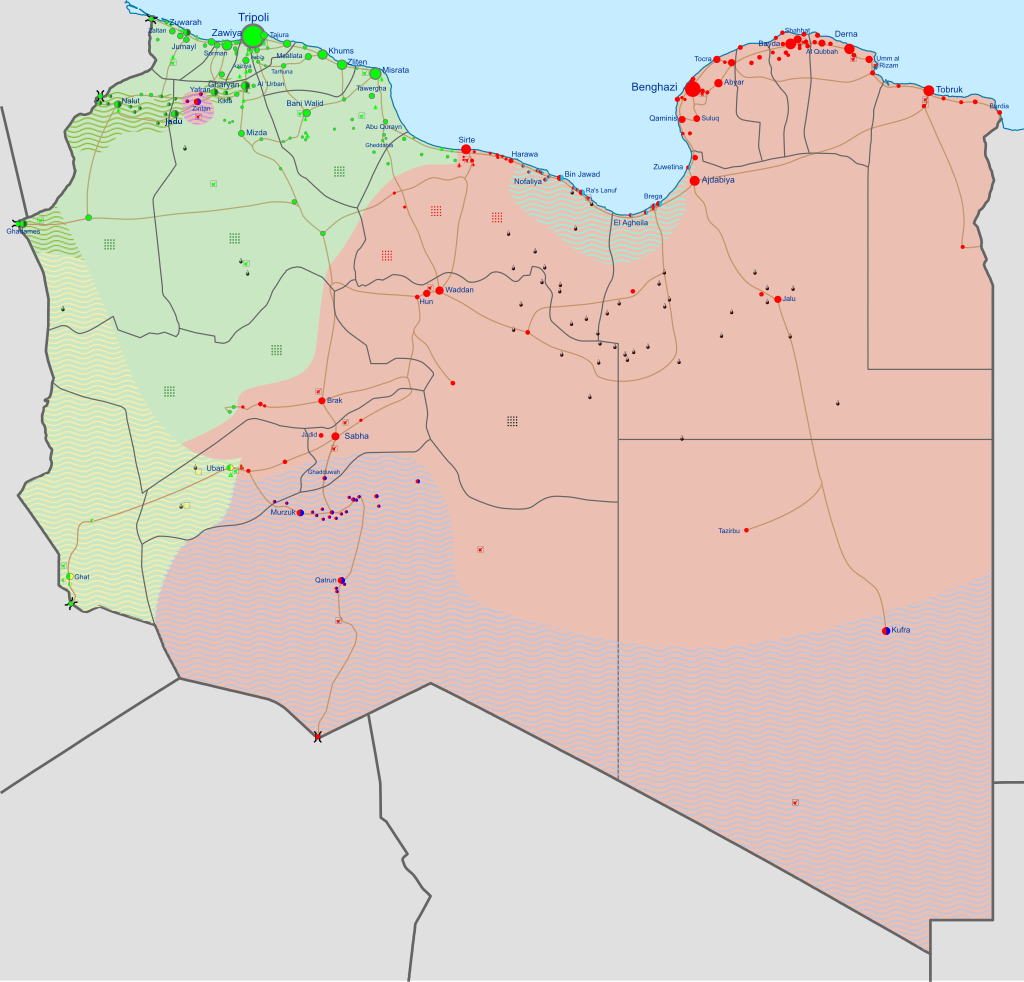
Today, Libya is in, effectively, two pieces: The coastal East and the rest.
Both governments have, since the 2020 ceasefire, worked to use the relative calm to consolidate power and bring the militias within their territory into their respective militaries. Meanwhile, the conflict sits frozen with only the odd skirmish between both sides.
The UN has not given up on rebuilding Libya and forming a united government. In May this year, they produced a new road map for reunification and new elections (after all, I’m sure the seventh government will unite the nation and succeed); however, since this road map was published, little has changed and there is no reason to think much will. Neither government seems willing to hand over power and fresh elections may remove from power those who now control this broken country.
Words by Archie Sykes
Sources:
https://www.aljazeera.com/news/2021/1/14/arab-spring-ten-years-on
https://www.theguardian.com/world/2011/mar/19/libya-air-strikes-gaddafi-france
https://www.britannica.com/event/Libya-Revolt-of-2011
https://www.dw.com/en/between-chaos-and-democracy-libya-at-crossroads-again/a-72733882
https://www.theguardian.com/world/2020/may/18/war-in-libya-how-did-it-start-what-happens-next
https://www.cfr.org/global-conflict-tracker/conflict/civil-war-libya