
Rick Owens: Menswear in the Mist
The Lord of Darkness offered his satirical stance in the Palais de Tokyo
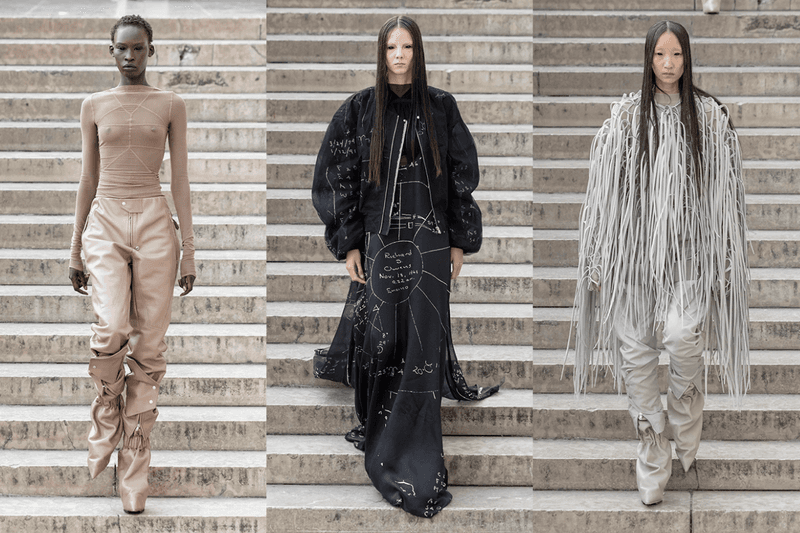
Where are we, exactly? And when? Police boots stomping amongst the fog-clad runway suggested a baltic dungeon. Leather military jackets over taut skin and stony faces said an alternate realm, many years into the future. Rick Owens’s ‘Men’s Tower’ is nothing short of its title. Disproportional silhouettes emerging from fog, and sporting layered armour gaunt in its length, gave the show a distinct preternatural feel. It made me realise just exactly where we were: in a parody of modern authority and industriality.
Owens’ unabating soundtrack, ‘Ultratronics 13’, from the ‘Ultratronics’ album by Japanese composer and producer Rjoy Ikeda, immediately piqued my interest. As an avid lover of electronic and techno music, I was transcended into the critical and radical aesthetic of power upon hearing the first opening beats – something around 160 per minute. High-speed music paired with a steady delivery of each model in ‘bloated’ platform-police boots, stopping just below frayed ¾ trousers, created a heavy and eerie industrial feel. Glossy leather lab coats and boxy utility jackets with popped-collars produced stark and unearthly silhouettes. Aside from the clothing, bleached brows, rigid slick-backs and harrowing smoky eyes with piercing bottom lashes were prevalent, framing the model’s faces to appear beyond the supernatural. Almost like they were made in his factory. Perhaps the most intriguing pieces; the floor-length macrame masks in black, pink, and grey, were hand-knotted by Lucas Moretti, who spent thirty hours on each one. All the while, the music continued almost like an eerie minimal white-noise, yet fundamental to the show’s juxtaposing nature.
‘Tower’ is a title that is complex in its meaning. Referencing ‘Temple of Love, Tower of Light’, the phrase suggests hope and loyalty. Yet visually, this connotation is complicated. Owens’ notion on towers, implied by his towering models, serves as a critical message towards authority, control and observation. Police boots in nonsensical sizes and colours labelled as Butch Black and Mincy Mauve unsettled typical displays ofpower. Kevlar, a fiber typically used for protection, coated Owens jackets. Utilising surface-level parody is perhaps one of the only ways to convey the underlying sincerity of Owens’ message: ‘“What does one do with fear or concerns like that?” You make fun of it. You mock your oppressors.’.
Words by Amber Williams