
Ink Stains
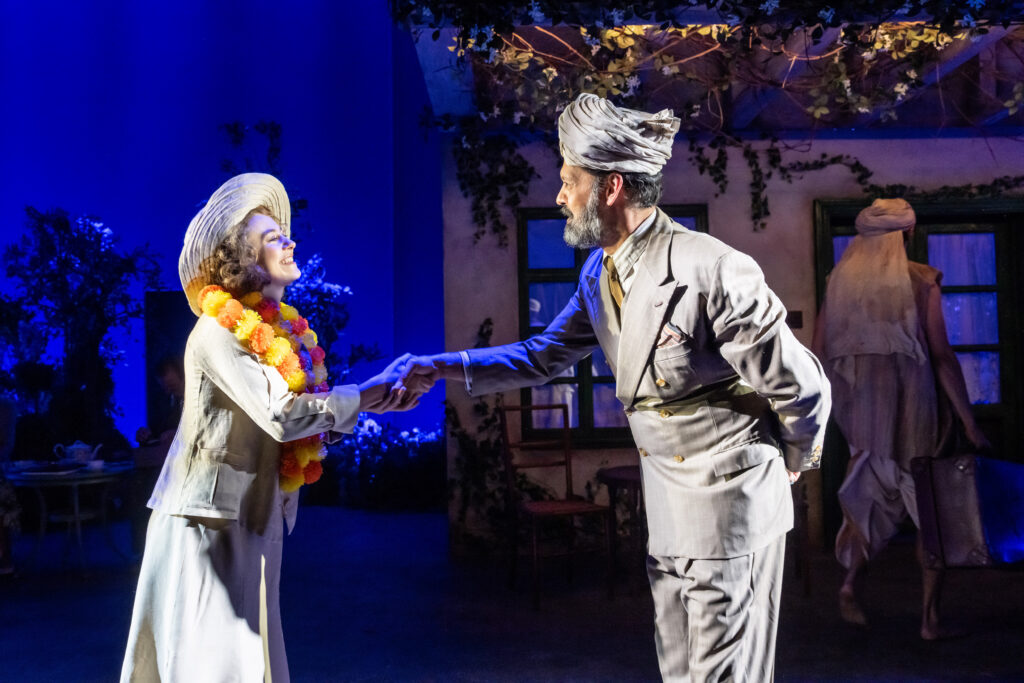
Image credit: Johan Persson, Hampstead Theatre
Oscar Glanfield reflects on Indian Ink, the revived Tom Stoppard play exploring love and art between England and India.
Kolkata has a diverse architectural landscape, from traditional Bengali to the Neoclassical introduced by British rule. The most beautiful Neoclassical and Palladian palaces of the capital city were built by Bengali rulers in admiration of the new style. Ravi Varma, whose work still trickles into contemporary Indian iconography, adopted the Victorian academic style when representing his home country and mythology. Oddly enough, he never attended the local art Institutions which based their curriculum on the South Kensington School of Arts. He privately trained under European and Indian teachers, and his style is his own.
These are anecdotes relevant to the incoming discussion. I am looking at “Indian Ink” from this angle, knowing that culture is an infinite palimpsest and that tabula rasa is impossible. I’ll be getting back to this.
What does it mean to have a shared history? The interpretation of the whole depends on the individual. 1857: Revolution, or Mutiny?
By virtue of this being the very first mainscale posthumous production of a Stoppard play, the dots become eager to connect.
What will Stoppard become in a Stoppardless world? How will we tell his tales now? And whose tales is he telling anyways?
We see the history the biographer will be sharing with the world and think we know better. After all, we know the real Flora Crewe, she’s stage right.
Of course, that entitlement to understanding rings true of her as well as us.
Flora models herself as a bright young thing, from a world between Beaton and Bundle and Bloomsbury, a literary socialite whose own writing seems as un-averse to scandalous titillating as the dutiful letter collecting Academic is. Of course, the shock of her dubiously lascivious façade is a story, one which is trending. Similarly, she asks for a similar character out of Nirad – the same jocular jousting he is meant to partake in, to stop playing the perfect Indian and instead the perfect rebel. This is just swapping a trend for another, and Nirad is aware of this.
But are we? England and India have a shared history- forcefully shared. They hold expectations for each other, ideals in servitude of a personal reality.
We have expectations of Stoppard and now, those expectations are all that’s left. So what is left in death? In this play there are two answers.
The first is that we are remembered by what we produced and what others make of it, shaping it to their present. The other is in loved ones left behind, waiting their turn. This production brings these two together: the output left behind, and the loved one. Felicity Kendal, through her own shared history, tethers the work to a reality, playing Flora in 1995 and returning as Mrs Swan this year. On stage, she is the last one left remembering- we can only witness the knowledge that we never will.
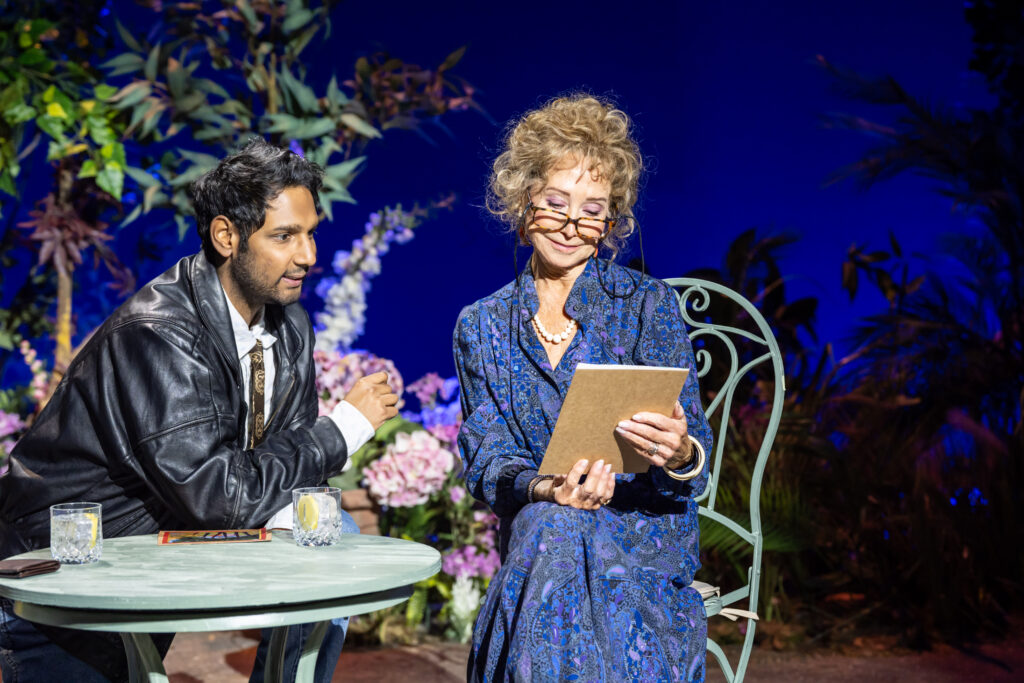
Nirad has a moment in this play in which he heaps praise upon British literature, bemoaning that the country he should hate is in equal measure capable of beauty. That sentiment, sincere or enforced, is what gave birth to Kolkata’s landscape and Varma’s portraits.
It is also likely to give birth to the new Stoppard. A man who broke out by rewriting Shakespeare will get his own reinterpretations (theatrically, not textually) in the following decades. We can only hope his memory doesn’t get burned in the passing of the torch. Stoppard has always been a highly contemporary writer, in spite of his oft historical hopscotching. This production suffers from the mere fact that it lies in an intermediate place- as the last wave bye, it cannot be unfamiliar. Yet by association to this bygone era, the age of Stoppard, it begins old before taking its first steps. Stoppard was always highly contemporary, but then again, so is Ibsen and yet he remains fresh. The production of “Arcadia” in March may give us a better sense of where we are heading with the work he leaves behind. Hopefully history can share in both directions- that the Now may give back to the Then.
Words by Oscar Glanfield