
What if Yuri Gagarin had never gone to space?
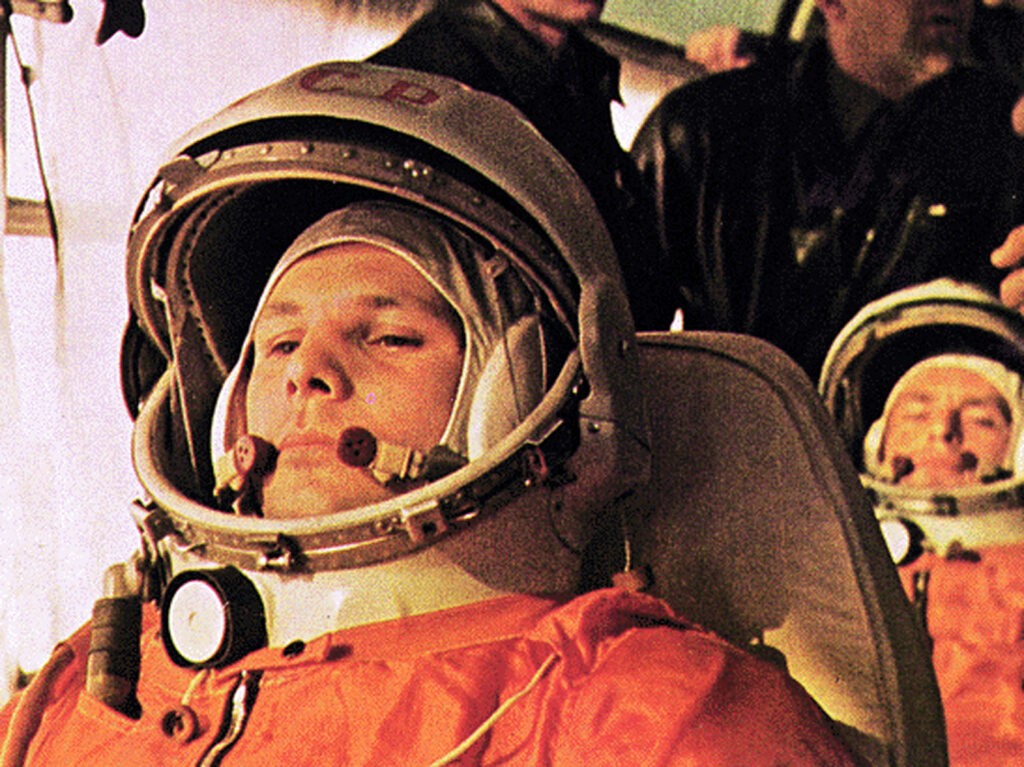
Image Credit: ITU Pictures CC by 2.0 - Flickr https://www.flickr.com/photos/itupictures/16042132243
12 April marks 65 years since Soviet cosmonaut, Yuri Gagarin, became the first human to voyage into outer space. His 108-minute orbit around the earth in a converted nuclear missile served as a key scientific development and a pivotal event in Cold War politics. This article explores the consequences of this success as well as a hypothetical world in which this landmark event did not occur.
Gagarin served in the air force before his 1959 qualification for the Soviet space programme, which had already achieved numerous firsts, including the first artificial satellite, Sputnik in October 1957; the first living creature in space, Laika the dog, in November 1957; and the 1959 Luna 1, Luna 2, and Luna 3 missions to be the first to pass close to the moon, impact the moon, and photograph its far side respectively.
At this time, the US and the USSR were engaged in an impassioned battle to develop greater technologies, including nuclear arms, and each victory in space was a propaganda tool to prove ideological supremacy.
Gagarin’s voyage and its impact
With Vostok 1, Gagarin made history. He also became the first space hero, famously charismatic and humble, and was highly valuable to Soviet propaganda. He became an internationally celebrated symbol of human progression, bolstering the Soviet’s image on the global stage as well as domestic morale
Alternate timeline 1: If Vostok 1 never launched
In an alternate timeline where Vostok 1 does not take place, the US would likely champion the first human in space. There had been a wave of anxiety surrounding the technological gap between the US and USSR following the launch of Sputnik, known as the Sputnik Crisis, leading to the development of the Space Race.
NASA was founded in 1958 in response, with one of its first initiatives being focused on sending man into space, culminating in the successful mission of Alan Shepard in Freedom 7 on 5 May 1961 just three weeks after Gagarin, although it was suborbital. Thus, American morale and confidence in the 1960s would be far higher, which perhaps would weaken the drive for greater development in astronomy, which was so rooted in national anxiety. Notably, with less panic, the famous 1961 lunar pledge by John F. Kennedy may not have been made, and humans likely would have set foot on the moon at a later date.
In addition, the balance of global prestige in the climate of the Cold War would be slightly altered, perhaps encouraging non-aligned nations more into the American sphere of influence.
Ultimately, with the technology and momentum of both the US and USSR, the first manned space flight would still have occurred, but at a later date and perhaps without such a charismatic figure to champion the title of first man in space.
Alternate timeline 2: If there had never been a Soviet space programme
In a more dramatic alternate timeline, what if the USSR had had no space programme at all?
To begin, the absence of the Sputnik Crisis would result in a much slower beginning to the US space programme. The establishment of NASA, as well as the strong drive for space and nuclear technological development were all a response to early Soviet firsts. Therewithin, achievements made would have less national celebration without Soviet competition.
Whilst satellites would likely still have been developed at a later date for military or scientific purposes, the US most likely would not aim for a human moon landing, as it was a direct result of an overall sentiment of urgency. Governments would perhaps prioritise domestic spending over costly space missions, and in space, take fewer risks and ultimately make slower progress. On the other hand, such missions would perhaps see greater success under wider international cooperation, no longer spearheading Cold War patriotism.
Furthermore, when missions would eventually take place, they would likely be smaller and focus more on testing than on spectacle, perhaps focussing more on robotic missions.
Early Soviet wins in space were crucial propaganda tools, and without them, the US would appear far more dominant in the polarised Cold War climate, with the USSR losing much of its soft power. In the absence of a space race altogether, the struggle for soft power may have taken place in the battlegrounds of industrial or, to an even greater extent, missile development.
In 1968, Apollo 8 astronaut William Anders took the Earthrise photograph, often cited as the most influential environmental photograph ever taken. With American society reeling from the Vietnam War, political assassinations and experiencing significant social upheaval, it provided a globally unifying image. The image of a blue oasis in an empty sea of darkness captured the isolated nature of the planet. The image is frequently linked with the foundation of Earth Day, the first being in 1970, and ultimately, inspiring contemporary environmental consciousness. Such imagery would emerge at a later date, resulting in altered attitudes towards the climate in this period. Environmentalism would likely still emerge, but with less unifying imagery.
Concluding thoughts: An altered yet inevitable space saga
Ultimately, if Yuri Gagarin had not become the first man in space in 1961, it would have altered the competitive political landscape of the Cold War in the following years, with the balance of soft power shifting more in favour of the US, but with landmark achievements likely stalled. In the absence of a Soviet space programme altogether, space exploration would have been much slower and have taken on a different, more subdued, form, with space exploration likely remaining scientific rather than political. The competition between the US and USSR would likely have heightened in other fields.
Words by Daniel Spencer