
Why is the Strait of Hormuz important?
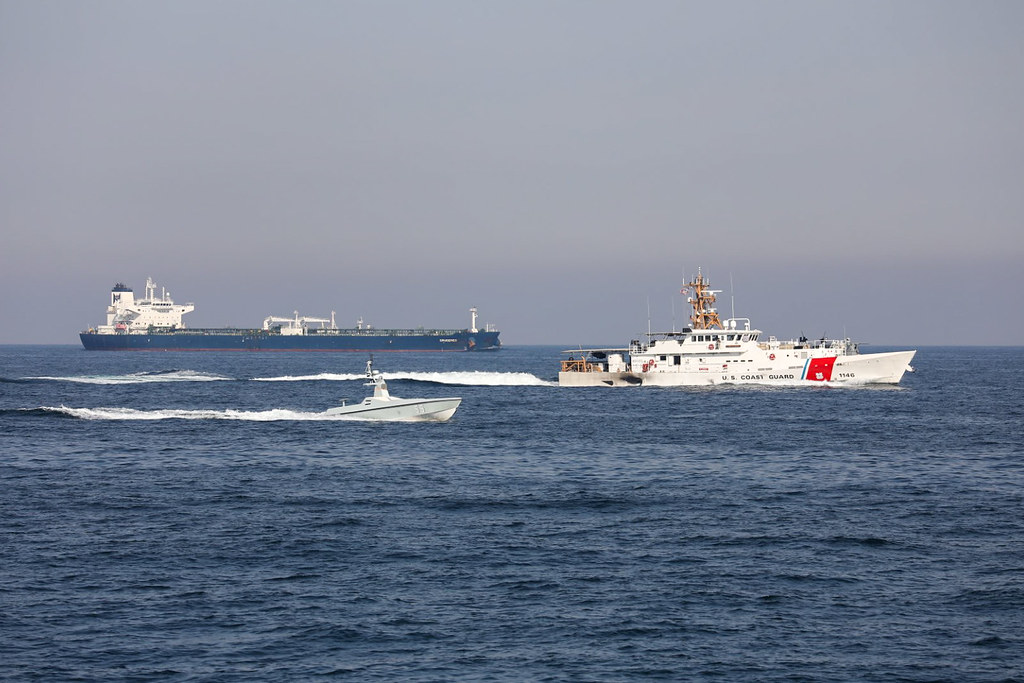
Image credit: Flickr
Much of the world’s fuel travels through a waterway 20 miles wide at its narrowest point: The Strait of Hormuz. Lying between Iran and Oman, it is often ranked alongside the Panama Canal, Suez Canal, and the Malacca Strait in terms of global strategic importance. Its position between the oil-rich nations of the Persian Gulf and the open ocean grants it significant geopolitical leverage. If the importance of this waterway isn’t yet clear, I’ll add that 20% of the world’s oil and LNG (Liquified Natural Gas) passes through it, as well as 30% of the world’s nitrogen fertilisers. It is one of the most valuable maritime choke points worldwide. Political tensions in the area therefore have global ramifications.
The Strait of Hormuz has a long history as a stage for international conflict. Beginning in 1984, the Tanker War phase of the Iran-Iraq war saw tankers in the area targeted by both sides. Furthermore, in 1988, Operation Praying Mantis saw a US attack on Iranian naval targets following the mining of an American warship. More recently, global markets have been kept on edge by periodic Iranian threats to close the strait in response to sanctions or military pressure.
Connecting exports from the Persian Gulf with global shipping routes, roughly 20 million barrels of oil are transported through the strait daily. Following the US-Israeli strikes in late February, and the subsequent conflict and the closure of the strait in early March, Asia was significantly affected. Asia makes up 89% of total oil flow by destination and China and India alone constitute around half of the total.
The closure of a major trade route such as the Strait of Hormuz causes a tangle of halting and rerouting ships, escalating shipping costs, insurance risks, and supply chain panic, which can ripple across borders and industries. Therewithin, oil prices surged, from around £70 to a high of £92 per barrel; the highest ever monthly increase. Even short-term closure can lead to panic-buying, use of reserves, and long-term price volatility. Furthermore, the swell in fertiliser prices and subsequent scarcity during planting season could severely disrupt global crop yields, especially as fertilisers have no reserves as oil does. Nitrogen fertilisers are crucial for staple crops such as wheat, corn, and rice, so disruption in their supply can lead to cascading effects in reliant countries, and subsequently, global food prices.
Part of the strait’s importance lies in its militarily strategic topography. Due to its confined form, relatively small forces can exert heavy influence. Iran maintains fast attack boats, naval mines, and coastal missile batteries.The United States and other allied navies hold a presence in the Gulf to ensure free passage, engendering a geopolitical arena.
Environmental risks comprise another layer of complexity, as attacks on oil tankers can cause spills detrimental to marine ecosystems and coastal economies.
Even as the world accelerates towards more renewable energy sources, the strategic importance of the Strait of Hormuz is unlikely to diminish in the near future. While solar, wind, and alternative fuels reduce long-term dependence on Persian Gulf oil, the pace of global energy transition remains gradual, meaning fossil fuels will remain critical for decades to come. Moreover, the enduring significance of the region will continue to be moulded by the geopolitical landscape and the regional ambitions of global powers.
The recent conflict has demonstrated the fragility of free movement through the strait and the shockwaves sent by its closure, including ubiquitous inflation, a worldwide energy crisis and food security risks. The restrictions imposed by Iran following the US-Israeli strikes have triggered one of the most significant energy crises in decades. Although intermittent reopenings of the strait have emerged from negotiations and international pressure, the situation remains unstable, with American naval presence increasing and Iran continuing to use the strait as leverage.
Ultimately, the Strait of Hormuz is a linchpin of global economy and trade. The economic artery links some of the world’s most resource-rich nations to global markets. Regional instability pulsates through global energy prices, agricultural markets, and geopolitical stability, the current conflict reaffirming the strait as a key consequential global epicentre.
Words by Daniel Spencer