
Britain is becoming a less charitable nation… Charities losing money and hope
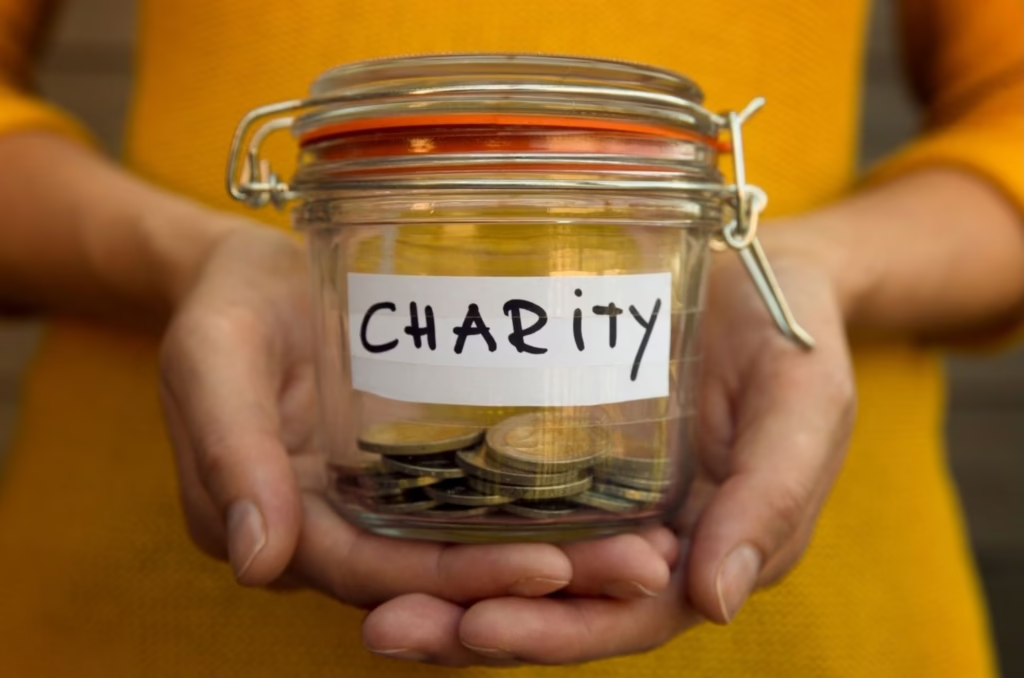
Image Credit: Giving What We Can
Fewer Britons than ever are donating to charities, according to recent studies, while government support is failing to keep pace with rising demand. Despite widespread recognition of the vital role charities play, the sector is under increasing strain — caught between declining public contributions, rising operational costs, and structural barriers that make it more difficult to sustain services.
Research by the Charities Aid Foundation in 2025 highlights a steady decline in charitable giving across the UK. At the same time, the cost of delivering services has surged, driven by inflation, wage increases, and growing demand following the Covid-19 pandemic and ongoing cost-of-living pressures. Charities are increasingly being forced to do more with less, filling gaps left by shrinking public services.
This contradiction is stark. The National Council for Voluntary Organisations (NCVO) estimates that the sector delivers over £14 billion worth of public services on behalf of the government. Yet funding has not kept pace with this responsibility. The government’s own 2025 Charity Sector Risk Assessment shows that cases of charities facing insolvency or serious financial difficulty nearly doubled in just one year.
To understand how these national trends play out locally, I spoke to Sunshine & Smiles, a Leeds-based charity supporting people with Down syndrome and their families.
Founded in 2011 by a small group of parents, the organisation now supports around 200 families, offering activities ranging from swimming and sports sessions to youth groups and school workshops. Despite its growth and impact, financial stability remains a constant challenge.
Service Manager Ailith Harley-Roberts explains that while the charity receives a small annual grant of around £7,000 from Leeds City Council, this barely scratches the surface of their costs. “Our swimming sessions alone cost us £10,000 a year,” she says. “When you add football, yoga, music groups, staffing, and everything behind the scenes, it doesn’t go very far.”
Like many charities, Sunshine & Smiles deliberately avoids relying on a single large funding source. Instead, they piece together income from small grants, trust funds, donations, and community fundraising. While this reduces vulnerability to sudden funding cuts, it creates a constant cycle of uncertainty.
“You always have to be thinking, where is the next £10,000 coming from?” Harley-Roberts says.
Even successful initiatives can expose deeper structural problems. The charity’s cafés, ‘21Co.’ in Headingley and ‘Café 21’ in Hollybush, which provide paid employment opportunities for people with Down syndrome, generate income but ultimately cost more to run than they bring in due to the high level of support required. Despite this, the organisation remains committed to paying its workers – a deliberate choice in a sector where many similar opportunities are unpaid.
“We were really clear that this was about work and being paid,” she explains. “It’s about independence and equality.”
Yet policies intended for businesses can unintentionally penalise charities. After surpassing the VAT threshold due to café income, Sunshine & Smiles was required to register for VAT, meaning they must pay tax on revenue that is not profit.
“That £95,000 isn’t money we’re keeping,” Harley-Roberts says. “We’re already spending more than we make running the cafés. But we still have to pay VAT on it. That’s money that could go straight back into supporting families.”
This reflects a broader concern across the sector: that government frameworks do not adequately account for how charities operate. While some tax reliefs exist, many organisations argue they are insufficient, particularly as rising National Insurance contributions and wage increases add further pressure. However, the NCVO’s CEO, Sarah Elliott, is not entirely pessimistic and hopes that the recent increases to the National Minimum and Living Wages will hopefully lead to less reliance on charities. Yet, Elliott equally acknowledges that higher wage costs “will add pressure when funding isn’t keeping pace.”
At the same time, competition for funding has intensified. Harley-Roberts notes that fewer grants are available, and more organisations are competing for them, including not just traditional charities, but also corporate foundations, universities, and even public institutions that have established charitable arms to supplement reduced government funding. This is reflected in the top ten charities in England by income, which, as of the 13th April 2026, includes the likes of Cardiff University and Lloyd’s Bank’s own foundation, among others.
“There are a lot more charities now,” she says. “And you do sometimes question what counts as a charity.”
Fundraising itself has also become more difficult. What was once a distinctive act – such as running a marathon for charity – is now commonplace. Additionally, fundraising platforms and events often take a percentage, turning parts of the sector into what she describes as “big business.”
The cumulative effect is a sector increasingly focused on survival. While Sunshine & Smiles recently avoided a £30,000 deficit thanks to a successful crowdfunding campaign, Harley-Roberts is clear that such efforts are not sustainable year after year.
“You can’t keep asking people for that level of support all the time,” she says.
This raises a broader question: who is responsible for sustaining charities?
Harley-Roberts describes it as a “shared responsibility.” Charities exist to meet needs not met elsewhere, but as public services have been reduced, particularly since the austerity measures of the early 2010s, the burden on them has grown significantly.
“The charity sector has picked up what statutory services can no longer provide,” she says.
Yet public willingness to give is declining, and trust in charities has fluctuated in recent years. Meanwhile, large, well-known organisations continue to dominate both public attention and funding, leaving smaller, community-based charities struggling to compete – despite often delivering highly specialised and essential services.
The result is a system under strain from multiple directions: fewer donors, higher costs, more competition, and structural barriers embedded in policy.
Still, demand continues to grow.
For Sunshine & Smiles, the future includes ambitious plans for a dedicated community building – a space that would bring together their cafés, support services, and activities under one roof. But achieving this will require significant funding in an already challenging environment.
“It’s our dream,” Harley-Roberts says. “But it’s a big ask.”
For now, it is enough that the charity helps those it supports to realise their own dreams. I spoke with Francis Henry, 26, one of fifteen adults with Down syndrome employed at the charity’s cafés. While many workplaces might not have given him the same opportunity, Sunshine & Smiles did not hesitate, and he has been working there since his teenage years.
Since then, he says his confidence has grown significantly. Alongside his work in the café, he has developed a passion for dance and theatre – ambitions the charity continues to support. Francis has already toured the UK and parts of Europe with the National Youth Dance Company, showcasing his hip-hop performances to wide audiences.
Support extends beyond the charity itself. Francis credits his family as central to his journey, with his mother even helping out at the café. He is also inspired by those around him – his sister, currently performing in Cats the Musical, and his friend George Webster, who is also a person with Down syndrome and has risen to national prominence as a BAFTA-winning presenter on CBeebies.
As Britain grapples with economic uncertainty and shifting public priorities, the role of charities remains as crucial as ever. But without meaningful changes – whether in public engagement, funding structures, or government support – many organisations may find it increasingly difficult to continue the work that communities rely on.
The question is no longer just how charitable Britain is, but whether the system itself allows charities to survive. We must ensure continued support.
Words by Jacob Edwards