
My jeans are made of kilim: A take on the American Eagle Ad
On the American Eagle ad that got the world arguing about eugenics and what it means to wear your heritage, especially when fashion sells identity.
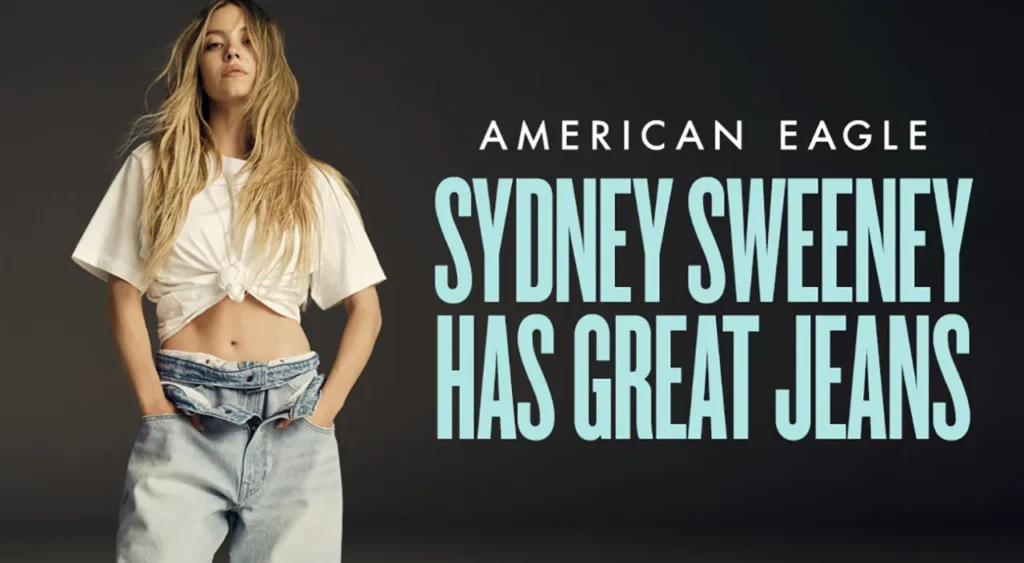
Image credit: American Eagle
I first came across Sydney Sweeney’s campaign for American Eagle while I was mindlessly scrolling on TikTok— a chamber where all my opinions echo back to me before I even know I have them. Her eyes beautifully contrasting with the meticulously arranged backdrop and jeans that looked as if they had been cut from the media’s favorite cloth; effortless, stereotypical beauty. The opinions did not stop when the video did, unraveling like the hems of those jeans. It was only then that I looked at mine, red with motifs on them, reflecting my culture. The fabric heavy from the labour of the hands of those who made them. My jeans weren’t like hers, they told a different story than whatever puritan idea she was styled to sell.
It was one particular line that sent the media in a frenzy- “Sydney Sweeney has great jeans”. A lot of people caught the double entendre, replacing the word “jeans” with “genes”. This sparked a wide range discussion across multiple social media platforms concerning eugenics and what it meant to be “American”. Of course, what screams more American than a marketing sale that started with kicking out their natives and continues with kidnapping people off streets during ICE raids?
Eugenics is a term coined by Francis Galton that claims it is possible to perfect people and groups through genetics and the scientific laws of inheritance (NIH). This idea is not only behind advertisements, but also responsible for the majority of ethnocentric wars going on in the 20th century. Therefore, people were not wrong to assume this advertisement contained traces of eugenic ideologies — a white woman with blue eyes claiming her “genes” are great just because she fits the standardized mould of beauty. Advertising expert Robin Landa, a professor at Michael Graves College at Kean University, told Newsweek: “The campaign’s pun isn’t just tone-deaf—it’s historically loaded.” Some users took to Tiktok to say that the ad was “anti women” and not progressive. The user @jessbritvitch on Tiktok called the ad campaign a dog whistle, and the “rise of fascism in America” Ironically enough, an article published by Vanity Fair reveals that the American Eagle’s “Sydney” jeans sport a butterfly on their back pocket to raise domestic violence awareness as according to the company’s website, “that is what Sydney is passionate about.” Though one can’t help but wonder why an ad so focused on selling the idea of “purity” through a sexual tone would be associated with such a topic.
American Eagle did not hold back against the backlash. The CEO of the company, Jay Schtenstein told The Wall Street Journal; “”You can’t run from fear,” and “We stand behind what we did.” He also added saying, he would have never released the advertisement if he thought people were going to be offended by it. American Eagle took to their Instagram separately, simply stating, “ ‘Sydney Sweeney Has Great Jeans’ is and always was about the jeans.” Which was quite questionable because Sweeney stated “Did you see what I did there?” right after the repeated line by the narrator. There is something unsettling about a brand that uses an Eagle as their mascot — supposedly symbolizing the American Dream and freedom, will make an ad decorated with messages containing hand stitched racism and calculated conformity. Surprisingly, after the ad, The American Eagle sales grew, with the Sydney denim jackets selling in a day, and the butterfly jeans selling out in a week. The stock jumped 25% earlier this month after its second-quarter earnings report, in which the retailer highlighted the success of Sweeney’s campaign. “The iconic fall denim campaign with Sydney Sweeney affirms we are the American jeans brand,” Schottenstein said during the early September earnings call where a “record-breaking new customer acquisition and brand awareness cutting across age demographics and genders” had been seen.
This was not a first in the history of advertisement. The backhanded nationalist tone was familiar to some viewers, Brooke Shields’ Calvin Klein ad in 1980 featured the then fourteen year- old model stating, “Nothing comes between me and my Calvins.” The ad received endless scrutiny for sexualizing a minor, and here was Sweeney repeating the history— but this time with full intention. The angle and the camera clarity changed but the initial promise did not, that some genes are superior to the others. The ad also caught the attention of the President of the United States, Donald Trump with him commenting, “Go get ‘em Sydney” after it was discovered that the actress was discovered to be a registered Republican since 2024. He added saying, “That’s what I wouldn’t have known, but I’m glad you told me that. If Sydney Sweeney is a registered Republican, I think her ad is fantastic.” This added another layer to the ad concerning America’s current political climate. Given that Trump is currently deporting 59,207 immigrants off the country. This is when jeans and genes became one of the same, representing the ideology of nationalism and purity.
At the end of the day, each fabric tells a different story. They each have their own voice, history and memory. My jeans are not seamlessly stitched for sale. My jeans are made of kilim – made of the sweat, blood and memories of its culture. They promise me something more than what money could ever offer: Identity. My jeans are my story. In a market where everything is made to mindlessly consume, the bravest thing one can do is stand out and be proud of it.
Words by Özüm Ersoy