
Paul and Paulette Take A Bath: Historically Insensitive or Innovative Genre Subversion?
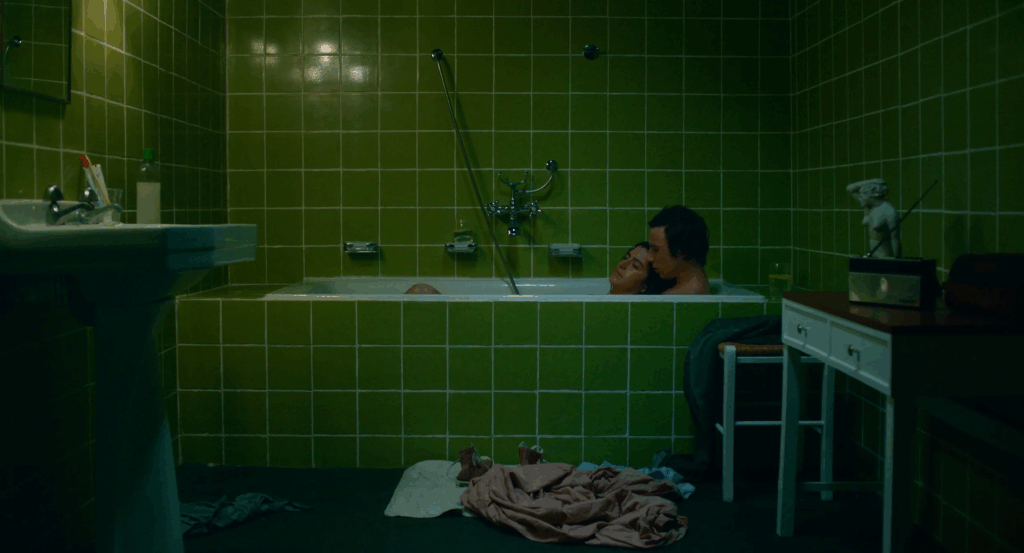
Image credit: Conic Films
Clara Swan reviews Paul and Paulette Take A Bath (2024), recently shown at Hyde Park Picture House, and evaluates director Jethro Massey’s deployment of Paris’s turbulent past in the romantic-comedy genre.
Paul and Paulette Take a Bath (2024), directed by Jethro Massey, is a romantic comedy laced with unconventional turns, an ambitious concept yet one that doesn’t completely come together.
Opening with an unusual meet-cute, Paulette, a chic French lady, and Paul, an American photographer, encounter one another in the streets of Paris whilst Paulette is amid her own self-directed historical reenactment of Marie Antoinette’s execution. By involving himself in conversation with her and taking on the role of the executioner, Paul finds himself with the duty of cutting Paulette’s hair in the same manner the executioner would have cut Marie Antoinette’s, short and exposing her neck to prevent it getting stuck in the guillotine blade just before her execution in 1793. This scene links the pair together and is the start of a complex bond where similar historical retellings and accounts, specifically morbid ones, are a central theme to their relationship.
The film follows the two around Paris, Munich, and Salzburg where they intentionally visit sights with a darker history behind them. They visit the Père Lachaise cemetery where in 1871, 147 soldiers were executed by the French army, along with the Jardin d’Acclimatation, a human zoo from 1877-1931 which ‘exhibited’ non-European indigenous people. The tragic historical fixations of this pair appear to be an attempt to create an edgy quirk and subvert the typical ‘rom-com’ genre, however the light-hearted and jokey way they treat these places makes this portrayal come across as tactless, and, in many cases, seem a slightly overt way of making their personalities appear complex .
In Paulette’s case, her light-hearted attitude and amusement with tragic events is most likely a redirection of her personal traumas, stemming from her complex relationship with her parents, which are briefly addressed in the film.
Yet, the audience is left guessing as to why Paul feels the same fascination. Is it just to impress Paulette?
When roaming along the picturesque Seine, Paul points out it was the spot where the police drowned Algerian protestors in 1961, possibly to show off his knowledge. However, it would have been interesting to see if there was an underlying cause of his grisly fixation.
Although the idea of showing the dark side of Paris’s frequently visited tourist attractions is an engaging comparison, the scale of balance is slightly off. There is still an interesting juxtaposition between the meet-cute, rom-com style of the pair’s friendship and the actual bleak and grisly bond they form over massacres and dictators. However, on occasion, the use of these profound historical events can be seen as exploitative to maintain Paul and Paulette’s eccentric relationship without delving any deeper into the effects and marks they left on Paris.
Although the film follows this rom-com style, Paul and Paulette by the end find themselves as nothing more than friends. Despite their various sexual encounters, Paulette finds herself hopelessly in love with Margarita, her on- and off-again girlfriend. The journey Paulette goes through to realise and face her flaws and commit herself to Margarita is a satisfying development of character and maturity, while adding a certain depth to her relationship with Paul, as he can be credited with helping her on this journey.
Paul clearly cares for Paulette and makes some bold choices to impress her whilst, simultaneously, grappling with some emotional issues. After renting an apartment nearby the site of the November 2015 terrorist attacks, Paul’s compassion for the attack’s survivors and grief for the murdered leads to a breakdown. However, the use of the attack to portray Paul’s development may be too recent to be used in such a context and could come across as insensitive and uncomfortable for a viewer.
The scene after which the film is named depicts Paul and Paulette visiting what Paulette assumes to be Hitler’s apartment in Munich (an idea Paul has falsely sold her) and taking a bath, pretending to be Hitler and Eva Braun. The blend of this fictionalised historical event with the harsh reality of Paul’s deception is an unusual mix, especially considering the light-hearted tone in which the pair play the roles of this couple. It is unsettling and inconsiderate rather than playing into an entertaining, dark rom-com portrayal.
Although the film incorporates good acting with an interesting premise, there is a lack of compassion when addressing Paris’s traumatic past. It appears too blunt in many cases without propelling the story along and thus the jokey blend doesn’t quite work. Paul and Paulette are compelling characters, so it is a shame that we do not get to see the true depth of their personalities.
Words by Clara Swan