
Review: Open Theatre’s ‘The Department of Lost Time’
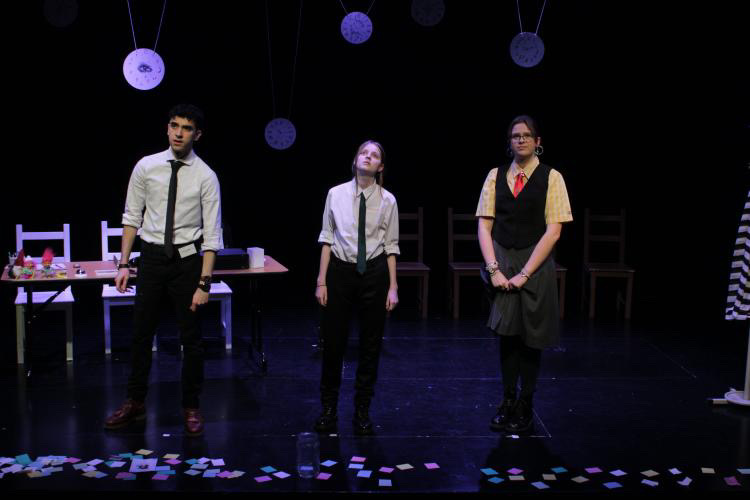
Image Credit: Ruby Baines
Lisa Clark reviews Open Theatre’s ‘The Department of Lost Time,’ reflecting on the play’s memorable moments.
LUU’s Open Theatre Society’s production of ‘The Department of Lost Time’ (written by February Hashimshony) was a vastly reflective and poignant piece exploring a government department which clients visit, attempting to redeem lost time. The captivating concept of the play primarily revolves around the clerks of the office, who throughout the play, experience the revelation that – no matter how much we try – time is irreplaceable.
From the moment you entered the building, you were immersed in the production with the opportunity to write a personal note on how you have recently wasted your own time, to then place it into a jar, resulting in immediate reflection from the audience. This jar became a prop later in the production as a collection of ‘wasted’ time, and a symbol of how easy it is for minuscule lost moments to equate into mass proportions.
Further reflection on the speed at which time can pass, was generated through the old-fashioned music which greeted the audience upon entering the theatre, and was later contrasted with Dr Dog’s Where’d All the Time Go? Creating the subtle allusion to how time passes, often without notice.
The production carried various weighted symbols, revealing the overall message of the play. I found it intriguing how none of the characters had conclusive names and were defined merely by how they’re spending their time. Furthermore, minor costume and lighting details: from the more stubborn clerk wearing three watches whilst the uncertain wore just one watch, (further disguised by other jewellery), to the colour theory within spotlights, were what ultimately made the production as impactful as it was.
Specific references to time also held an intriguing message; for example, the clerks having their lunch break, leading to citizens wasting even more time. In addition, the contrast between citizen two, who’s trying to redeem a whole day, speaking with great speed, and citizen three, who instead wants to subtract extra time, approaches the issue slowly with caution.
One of the closing statements lingered in the air, as a final, goosebump-worthy message sent directly to the audience.
“Start again tomorrow.”
Carrying a heavy weight, of both disappointment in the past, and hope for the future, the cast and production team put on a heartfelt and resonant performance – one that ultimately reminds us that there is no way to change the past, and we can only learn to cherish the moments yet to come.
Words by Lisa Clark