
‘What was that!’: Inside Lorde’s Virgin Era and the Ultrasound Tour
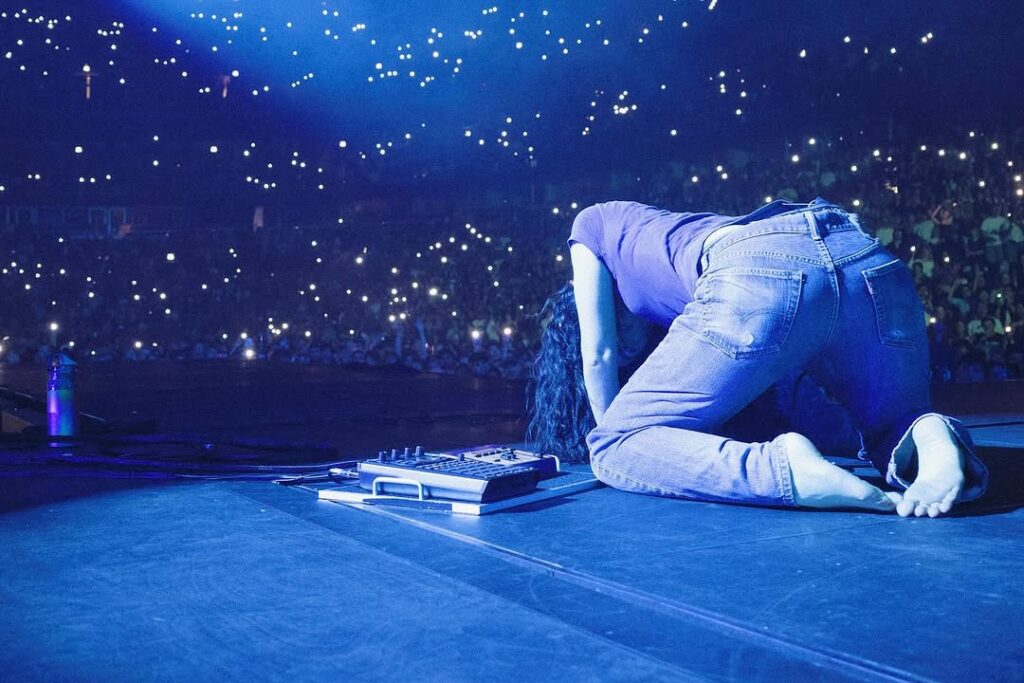
Image credit: @lorde on Instagram
This November, Lorde’s Ultrasound World Tour arrives at London’s O2 Arena, her first major run of shows since the Solar Power tour in 2022. Rather than a greatest-hits collection, the night centres on Virgin (2025), the taut fourth album she released in June, with older songs surfacing briefly as sharp flashes of memory.
The house lights drop, and the O2 falls into a thick, shared dark; a single blue beam drops from the rug and draws a hard line across the room. The first bass note shudders through the floor as she walks into a strip of light. Head tipped, mic loose on the side. When the wash finally lifts, the stage becomes almost bare: a raised platform, a treadmill, an industrial fan, and two dancers held at the edge. Lasers in cold white and blue light cut the space into lanes and boxes. From the first sweep of light, it’s clear what the set has been built to do; all this rigging exists to hold one thing steady, her body pinned dead centre in the frame.
The insistence on her body as the fixed point of the frame isn’t just a staging tic; it’s the live counterpart of what Virgin is already doing on record. Across the album, she circles the same pressures on the body, eating disorders, dysmorphia, and control. The body is starved, padded, scrutinised, something sexual, sometimes abruptly sexless, something to be managed and posed for other people’s eyes. ‘You tasted my underwear,’ she sings on ‘Current Affairs’, dropped in flat. Heard almost front to back, lines like that stop sounding like confessions and start to feel like private conversations we’ve barged in on, a low-level voyeurism the show makes impossible to ignore.
The show is watched through a small forest of lenses. Steadicams track her up and down the catwalk, another lens sits low at the lip of the stage, and a phone is passed between dancers in the mirror. On the big screen, those feeds are sliced together in real time, so what hangs behind her isn’t scenery but a live, shifting portrait of the same body seen from every angle.
During ‘Broken Glass’, her song discussing eating disorders, restriction and control, the whole room seems to tighten with her. She stands dead centre, while off to one side, a dancer sits calmly eating an apple, a small, unnerving picture of appetite. Halfway through the verse, she begins worrying at her belt, loosening it bit by bit until it finally slips free; the handheld camera dips to catch the slack at her waist, the exact moment her jeans begin to slide on her hips. Similarly, in ‘Man of the Year’, the gaze shifts upwards. She steps into a lit mirror at the centre of the stage and tapes her chest flat in slow, methodical strips, the silver flashing each time she smooths it down. Costumes never flip in blackout, they’re altered in plain sight and in close-up, folded into the beat as a run of small, practical gestures, a belt unthreaded, denim pushed to the floor, water thrown against her T-shirt.

In ‘Clearblue’, she pushes the same ideas through sound. The stage drops into an icy wash of blue, and the lasers close in, drawing a thin rectangle of light that she paces but never leaves. She sings into a vocoder that folds and hardens her voice, giving it a glassy, synthetic edge, while the main camera locks in unforgiving close-up, mouth on the microphone, face tinted the same pharmacy blue as a pharmacy blue, every vowel slightly blurred by the effect. Later, towards the end of the show, she finally slips that grid during ‘David’. She climbs down into the pit, hand on a shoulder, suddenly close enough to loom over people straight in the eye. The camera scrambles to keep up, lurching as fans reach out. For a minute, the perspective flips. Instead of watching her pinned in a box of light, we’re watching her disappear into the crowd that has been studying her all night.
All around the O2, clusters of school friends, couples, siblings, people who turned up alone start moving the way they do behind closed doors: hips late to the beat, arms too high, voices cracking on the choruses. When the ‘Pure Heroine’ and ‘Melodrama’ songs begin to play, the mood shifts. The cold, surgical blues of ‘Virgin’ soften into violets and hot pink ‘Supercut’ sends her sprinting on the treadmill while the lower tier runs and jumps with her, copying the forward-tilted gait and those small, faintly ridiculous shoulder shimmies that still look more like bedroom dancing than choreography. By the time ‘Ribs’ plays, you can feel the floor jolt, as if twenty thousand stomachs drop in unison. Phone screens drop. Little circles open in the aisles. People grab whoever is nearest, school, friends, boyfriends, strangers, and jump in loose, graceless loops, yelling lyrics learnt at fourteen into each other’s faces rather than towards the stage. The songs that once lived in headphones and childhood bedrooms are suddenly being tested at full volume against the fact that everyone else grew up with them, too.
When the confetti finally goes, it falls in slow sheets, each piece stamped with three small words, ‘You,me,us’ catching in hair and sweat as the last chorus sings. On paper, it’s an almost too-tidy bit of tour branding. In the room, it feels more like the show quietly spelling out what it has been doing all along. She once sang about ‘dancing in a world alone’, standing in the crush as the lights come up, and those scraps of paper cling to your clothes, you realise how many people grew up in that world with you.
Words by Christelle Al Abbasi