
European Super League – The Circus That Never Should Have Started (Opinion)
Credits: Fikri Rasyid on Unsplash
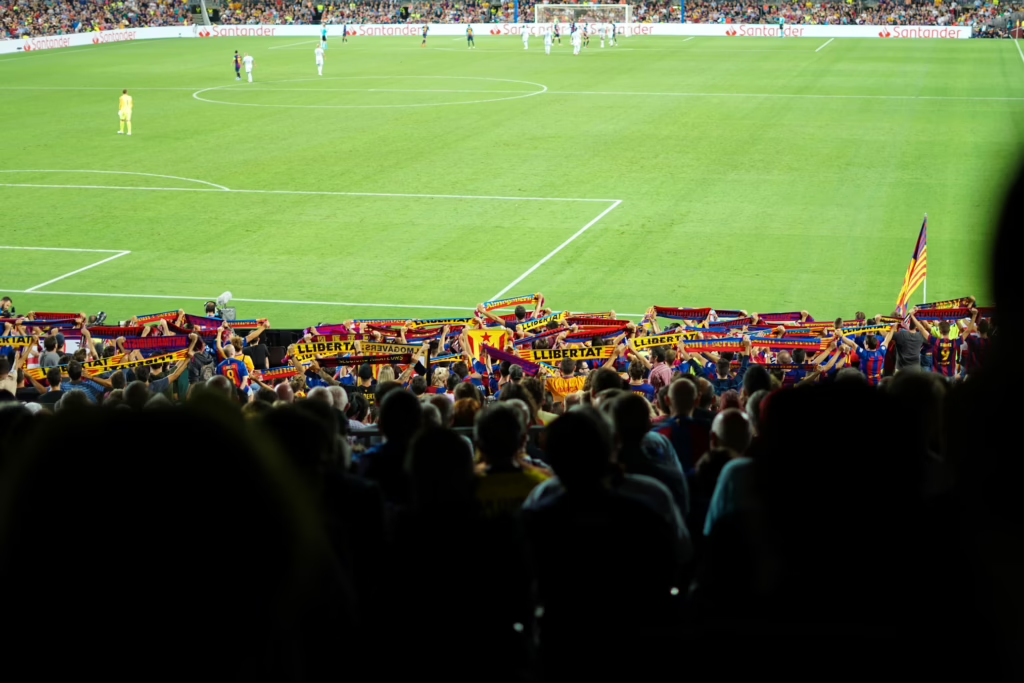
“FC Barcelona hereby announces that today it has formally notified the European Super League Company and the clubs involved of its withdrawal from the European Super League project.” As posted on the club’s official website on February 7th, the Catalonian giant has finally realised that they cannot continue to be the puppet of their biggest rival, Real Madrid, and its president, Florentino Pérez.
The idea of the Super League was first suggested by Silvio Berlusconi, the former owner of AC Milan, in 1987. Every time this proposal has advanced over the past 40 years, we’ve witnessed the big European clubs gloating in triumph and swarming in, only to walk away empty handed – or so it appears. Every time they do this, the European governing body, UEFA, has compromised on some of their demands: the rebranding of the European Cup, the recent expansion of the Champions League, and the promise of bigger matchups. This all generates more revenue. Despite this, the big clubs are never satisfied and will continue to push for more. However, this ‘campaign’ should never have started.
Emerging into history from the lush green lawns beside Eton College in the 19th century, football has long been a platform for people to gather, feel the strength of the group, and let out any frustration held within. Like chariot racing in the Byzantine Empire and bullfighting in Spain, it is never simply a form of gameplay: a tribal behaviour that reinforces a shared collective identity. Community is not only the foundation of the sport, but also the core of its very essence. Without this social function, all its commercial packaging offers nothing more than other forms of entertainment. Whenever an owner proposes sacrificing the club’s identity for some short-term commercial gain, we see a kind of “better to be broken jade than unbroken pottery” approach from the fans: protesting, boycotting the stadium until the problem is solved, no matter the results on the pitch. It is easy to explain their actions: if something has already lost its soul, despite how it may flourish economically, what meaning can it provide to this world?
Looking back at the concept of the European Super League, you’ll find it extremely hilarious. Although the promoters claimed the League’s aim was to “save the sport,” they are doing the exact opposite. If you are changing the core spirit of the game, how can you make the claim that you are saving it, or that the thing you saved is still it rather than the ship of Theseus? Football is based on sporting merit with promotion and relegation; every team can, and should, compete to earn their place in a tournament. If certain teams’ places are pre-confirmed, ‘the game’ isn’t such, as it will have lost its competitiveness. If you are depriving a financially smaller team of the chance to play in a bigger league against stronger teams, why should they keep working hard? In fact, what holds up the whole football industry is exactly these ‘small teams’. As the foundation of the pyramid, their existence gives millions of footballers the backing to chase their dreams; millions of fans a reason to be involved in the sport.
The European Super League failed, but it is foreseeable that the big clubs will come back and ask for more. Hopefully, this sport will never lose its soul. This soul, rather than any commercial development, is the real reason why it became the biggest sport in the world. The sport has reached a crossroads, and we must choose the path ahead: competition or cartel, merit or privilege, community or greed.
Words by Xingzhi Dai
2nd Image credits: Ahmet Kurt on Unsplash