
The Gorton and Denton by-election: A new era of British politics?
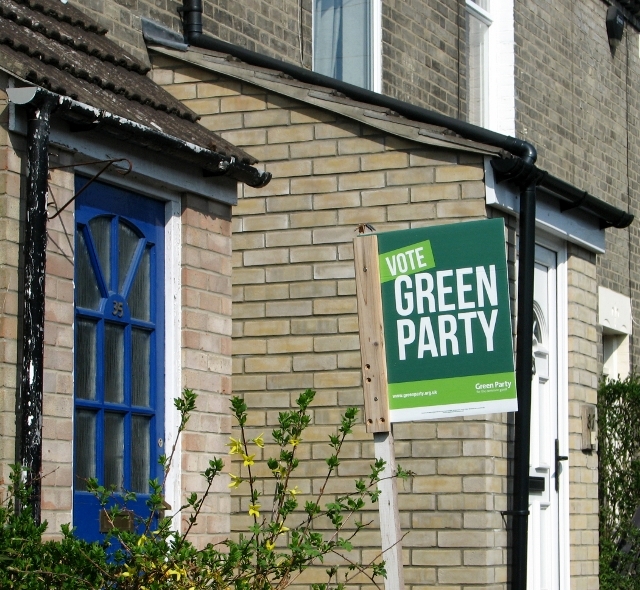
Image Credit: Creative Commons - Evelyn Simak
On Friday 27th March, the results of the Greater Manchester constituency Gordon and Denton by-election came in- a surprisingly comfortable Green victory- and a symbolic win for British politics. The by-election was triggered after the current Labour MP for Gordon and Denton, Andrew Gwynne, stepped down on health grounds, whilst being investigated for offensive messages sent in a Labour WhatsApp group. Whilst it was a minor vote in the grand scheme of British elections, its results and the way this race has unfolded has been very telling of the way in which British politics is headed.
During the campaign, it was a clear three-way race between Labour, Green and Reform candidates Angeliki Stogia, Hannah Spencer and Matt Godwin. Their campaigns varied dramatically, with the Greens’ Hannah Spencer emphasising her working-class Manchester background and career as a plumber, while centering policies around making life more affordable. Meanwhile, Matt Godwin pursued Reform’s anti-immigration politics, emphasising the housing crisis and tackling anti-social behaviour. The Labour candidate was keen to point out the divisive politics of Reform, and was even joined by Kier Starmer on the campaign, who criticised the Green Party for splitting the anti-reform vote. Starmer attempted to reinforce the narrative that third parties are a wasted vote due to the structure of FPTP, which as a system tends to overrepresent the major parties, reinforcing two-party dominance, and underrepresent minor parties that lack a concentrated support base. However, these election results have completely dismantled this assumption, showing that it is possible for minor parties to take power, and that Labour is not the only party that is capable of keeping reform out. This shock result will drastically empower the minor parties, and warn the major parties that they can no longer rely on ‘safe seats’ or disregard minor parties as unrealistic options, or wasted votes.
The vote increasingly became a Green vs Reform election, and this was evident in the final results, where Greens won with 40.7% of the vote, and Reform in 2nd place with 28.7%. Labour finished 3rd with 25.4% vote share. This is significant for a number of reasons, firstly because it illustrates the clear fragmentation of British politics and the increasing volatility of the electorate. Two minor parties finishing above Labour highlights how people have been pushed to the edges of British politics- it is clear the electorate are unhappy and wanting significant change, and this cannot be found in either of the main parties. This result indicates the weakening of two-party politics; the Conservatives achieved only 706 votes, and the total vote share of the Tories and Labour was 27.3%, a drastic comparison to the combined share of Green and Reform, 69.4%. With this election result in mind, it begs the question of how Labour and the Tories will fare in the upcoming local elections in May, and we can now confidently assume the local elections will only further collapse the two-party dominance.
Subsequently, many viewed this by-election as a test for the Kier Starmer and the current government, which he has now clearly failed. A Green win in a constituency that, in 2024 had a strong 50% Labour majority, and has been Labour since 1931 is an incredibly poor look for the Labour government. We can be sure that this will only prompt further criticism that the government has alienated their core left-leaning voters, and doubts surrounding Starmer’s leadership, especially since he made the decision to block Manchester Mayor Andy Burnham from standing- a decision that has been greatly criticised by Labour MPs. This loss is the first tangible manifestation of Labour’s unpopularity, and can be expected to only become more frequent as their term continues.
Overall, this result has been an astounding win for the Green Party, gaining their first MP in the north of England and their first win in a by-election ever. The recent surge in Green Party support and membership under Zack Polanski has actually had a concrete impact, gaining them influence in parliament. Polanski seems to have successfully revived the Green Party as not just a climate-focused party, but a general left-wing party that has a viable chance in elections- a ‘party of hope’. British politics grows more and more volatile, with people abandoning the two major parties for rapidly growing populist options, and these results suggest that this momentum will only continue through the local elections, and possibly even the next general election.
Words by Maya Vyas