
Unearthing GAIA: Where Philosophy Meets Fashion
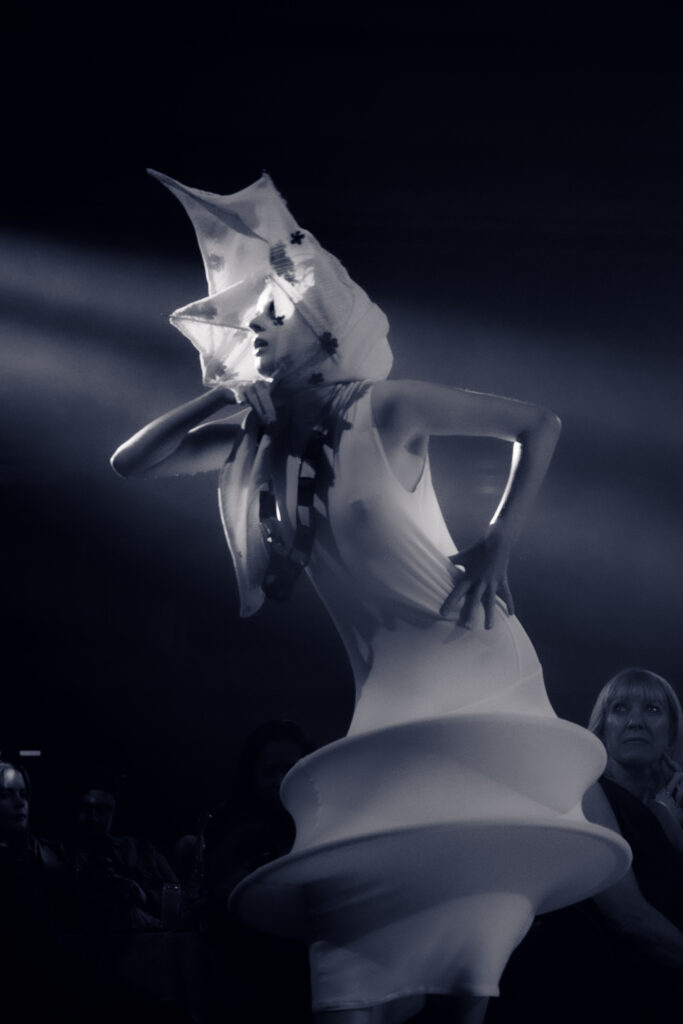
Originally a concept by Gilbert Ryle, philosophically, the term refers to the critique of the concept of the mind existing alongside and separate from the body. The concept has found itself within the fashion scene from as early as 2013; Leeds RAG reinvents this concept in a captivating manner.
This portion of the show differed greatly from the biophilic theme, in turn, postulating a world without Gaia… a world without nature.
The scene illustrated this dystopian world immaculately with designs showcasing muted greys and dark colours throughout. The designs themselves took inspiration from several differing cultures, but all matched the overarching melancholy of a world lacking in nature.
As if their souls had actually departed from their bodies, the models haunted the runway with vacant and ghastly expressions. The Frankenstein movement of some of them perfectly translates what the lack of a soul means to human expression. The insinuation that nature is our soul ties in perfectly with the current decline of fashion identity and the subsequent uprising of fast fashion, in turn. Using fashion as a language to condemn the wasteful cycles that homogeneous fashion forces some to undertake, urging one to value nature… value our soul.
The third scene, in its daringness, stood out as one of the most impactful for many in the audience. The haunting music, the dark space, was somehow made darker, forcing one to acknowledge the absence of Gaia herself.
Lighting played a crucial role within this segment, casting elongated shadows that stretched across the runway and further distorted the silhouettes of the garments. This created an almost spectral presence as each model passed, reinforcing the unsettling atmosphere that the designers sought to evoke. The garments appeared less like clothing and more like remnants of a forgotten civilisation, artefacts of a future where humanity has severed its connection to the natural world.
What made this scene particularly striking was its subtlety. Rather than relying on spectacle alone, the designs allowed the concept to speak through texture, movement, and restraint. The audience was left with a lingering discomfort, a quiet reminder of what could be lost if nature continues to be displaced by artificiality. In this way, the segment functioned not only as fashion but as a quiet philosophical warning woven directly into the fabric of the show.
Words by Abena Assiah