
Everyone’s Talking, But Who’s Saying Anything?
Emily Valentine writes about a culture of copycat content, and asks whether creators are chasing authenticity or just engagement.
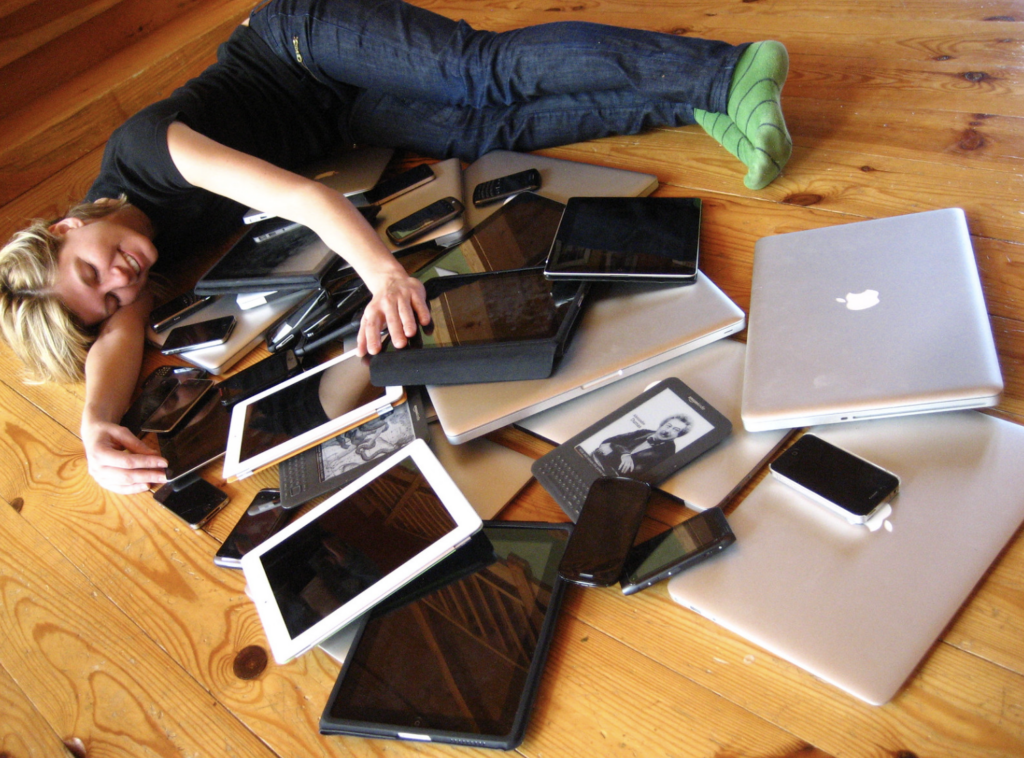
Image Credit: Jeremy Keith on Flickr
Who wants to be heard, and who has something to say?
Picture this: you go onto social media and wonder why you get the same topic, over and over, repeating the same topics and talking points out of different mouths. Then, you’re in the car listening to the radio, only to hear the same TikToker promoting their show. Later, you have to walk past Boots and see another influencer promoting their latest makeup collaboration.
Then it hits you: everyone online seems to be saying the same thing, in the same tone, at the same pace, using the same editing software, and posting the same platforms. They’re all chasing the same lifestyle and engagement as those who already achieved success. Or maybe I’m just a little whack-a-doodle in the head and reads too much into this kind of stuff.
But this is my issue.
There’s a blurred line between someone who wants to be heard and someone who has something to say. It feels like some people don’t know what they want to say, but they want to be heard by the masses. And look, I get it, we all desire to be heard and seen. But it feels safe and simplistic, repetitive almost.
I’m not trying to say people can’t have a muse or inspiration. Everyone does. Every story relates to mythology, every song has a demo, every painter has a technique taught. It feels like sometimes there’s a herd of sheep all shouting that they are the shepherd though.
‘What is love?,’ ‘How to find your niche,’ ‘What is classy?’
Plog. Vlog. Blog.
And while you’re at it, here’s some outfit inspo.
There’s nothing wrong with this kind of content, it is good content, you should be proud of the content you create. But I think if you’re going to do it, do it because you want to say it and not just because you want engagement.
And if you like that trending house style – cursive font, colour palettes, emojis, instrumentals, click-clack TikTok sounds, sparkle sparkle – then go for it. You get what I mean.
But I don’t think people should create content because people want followers and fame. They should do it because it brings someone joy and a sense of authenticity. It’s so much effort, but this effort should reflect someone as themselves, not others. My mum always says to me: “be yourself and you’ll attract those that want to be around you.”
I think it’s the same online, as it is offline.
This isn’t just a social media issue. It’s with marketing, films, and TV.
Think for a second: when was the last time you saw authentic media not based on a book or mythology? Even in interviews with ‘celebrities’, interviewers are trying to get their TikTok-worthy snippets. Bring up a question hinting at an ex, what Taylor Swift song would their character be, or imagine their character was in a different franchise. Oh, also here is a Jellycat that reminds me of your character.
It’s not a critique on the interviewer, in a cut-throat critical industry, you need to catch the ear and eye. As Hesmondhalgh’s cultural industry theory suggests, ‘you must minimise the risk to maximise the profit.’
However, I find it sad that creativity is limited to appeal to an audience that wants fast-paced content in an equally fast-paced industry. I know someone didn’t spend thousands of pounds and years at a top journalism school just to ask, ‘If your character was a Jellycat, which would it be?’
Words by Emily Valentine