
When humanity wins: A glimpse of the politics we deserve
Nicole Camacho writes about Zohran Mamdani’s electoral victory positively and within a comparative lens with Britain.
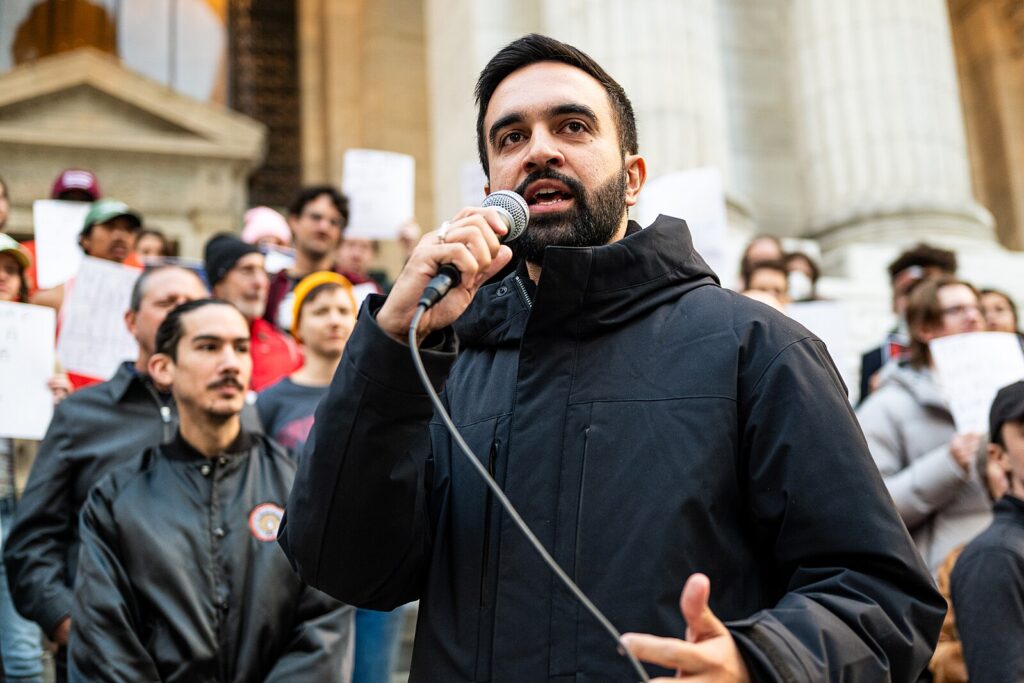
Image Credit: Wikimedia Commons
Watching a victory in New York stirred something rare – a reminder that politics can still feel human, and a longing to see that here in the UK.
Watching Zohran Mamdani’s victory speech as New York’s next mayor, from thousands of kilometres away, affected me in a way I didn’t expect. It carried the sense that this was bigger than just New York; that it might be a quiet affirmation that change for the better is still possible. It was a reminder that politics, at its best, is simply about people: community, care, and solidarity, not because we share a background, ideology, or identity, but for the simple reason that we share an existence.
Perhaps I’m giving Mamdani too much symbolic weight – or perhaps symbolism is the point – but seeing the community that lifted him up, recognised themselves in him, and fought for a future they could share, was powerful. It felt like watching democracy do what it rarely does anymore: reflect the lives of the people it’s meant to serve.
It called attention to something that has been missing in politics for far too long: humanity.
Mamdani standing on stage in front of broadcasters and his community, proclaiming: “We are in City Hall now”, felt like a moment of truth. Not because it was performative, but because this victory was never just his. It made plain just how starved we are for politicians who feel truly human – leaders who live where we live, feel what we feel, and fight for something better because they understand what ‘better’ actually is.
To understand why this victory means so much to New Yorkers, you have to understand the kind of politics Mamdani comes from. A young, democratic socialist and Muslim immigrant, he entered politics not through the usual corridors of power but through the slow, patient work of community organising. He represents a flicker of possibility for much needed change – especially in New York, a city hollowed out by a cost-of-living crisis so relentless that ordinary families are forced into impossible, dehumanising calculations about housing, childcare, and survival. Mamdani offered dignity as a starting point rather than an aspiration: free buses, universal childcare, rent stabilisation and strong tenants rights. These are more than policies; they’re statements about what a city owes its residents simply because they belong to it. This was an election built on care and the belief that communities should be nurtured, not managed. New Yorkers saw a leader who would name the crisis honestly and still insist that something better was possible, and worth fighting for.
Seeing a city choose that future so decisively made the distance between there and here feel impossible to ignore.
Our political landscape feels empty – drained of empathy, drained of imagination. Never compassionate. Never human. Instead, we are fed finger-pointing, scapegoating, and a steady stream of hateful rhetoric directed at our most vulnerable communities. Figures like Tommy Robinson and Nigel Farage – loud, reactionary, endlessly platformed – have shaped a national discourse where anger is ordinary and empathy is naïve. As an immigrant who has lived in the UK for nearly half my life, this shift is not abstract to me.
The resentment towards people like me rarely comes as a shout. More often, it slips into the everyday. A headline about settled status being revoked; an overheard complaint about the ‘flood’ of refugees; a neighbour muttering that our street is becoming unrecognisable; the uncomfortable moment of passing yet another St George’s flag on the high street, knowing what it symbolises. Yet, it all feels worlds away from the kind of politics Mamdani embodies.
He refused to soften his politics to make them more palatable. He centred tenants, migrants, and working-class families not as a checklist of demographics, but as neighbours. His win showed that campaigns can be built on care rather than fear, and unity rather than division.
Here, immigration is treated as a threat to be managed. Compassion is dismissed as unrealistic, ‘being realistic’ means accepting decline. Here, working-class and migrant communities are spoken about far more than they’re spoken with. Somewhere along the way, Britain stopped imagining a better future, and instead settled for keeping the decline at bay. That isn’t governance; it’s crisis-management dressed up as competence.
Within New York, the contrast couldn’t be clearer.
Hope is alive.
Whether we will allow it to live here too remains an unanswered question.
Words by Nicole Camacho