
John Atkinson Grimshaw Exhibition: A Walk-through Time in Leeds
Olivia J Nivaud visits the Leeds Art Gallery to discover the work of a great Yorkshire artist.
Being a first year in Leeds, I’ve come to find the best way of getting accustomed to a new city (and a new country for that matter) is by indulging in cultural tourism. I have found many museums in Leeds, as it is very rich in its history in art, and the Leeds Art Gallery which is home to many great Yorkshire artists.
Upon my trip to the museum this month, I stumbled upon an exhibit of John Atkinson Grimshaw: Don’t Let’s Ask for The Moon, where a series of his paintings were displayed. I had never heard of this artist, but I am elated to have found him as he portrays the Victorian industrial city of Leeds in a beautifully renowned way.
Within the exhibit, there are 13 oil paintings—4 of which are of Leeds—a photography book and a cyanotype print of Agnes Leefe with one of the Grimshaw children. This exhibit is quite small as the walk through itself is a small path in one room but that does not diminish its rich value of history. Grimshaw was known for his nocturnal scenes, his “moonlights” as he called them. There are two paintings that I would like to walk you through as they are the ones that spoke to me the most.
In his painting of Park Row, Leeds (1882) he depicts the prominent and iconic street of Leeds that many, like myself, walk every day. The first thing I noticed was Grimshaw’s moon—he placed it in the left corner as it illuminated the entire city. Now, I am not astrologically inclined, but I found out that it is impossible for the moon to be in this position, and yet, Grimshaw places it in the northern hemisphere regardless. The gallery had claimed this decision to be “an idealised moon for an ideal city,” and I couldn’t agree more. Truly, the moon draws you in, with its ashen clouds that swarm the sky. It feels like an entrapment of sorts, almost troublesome to look away from Grimshaw’s moon.
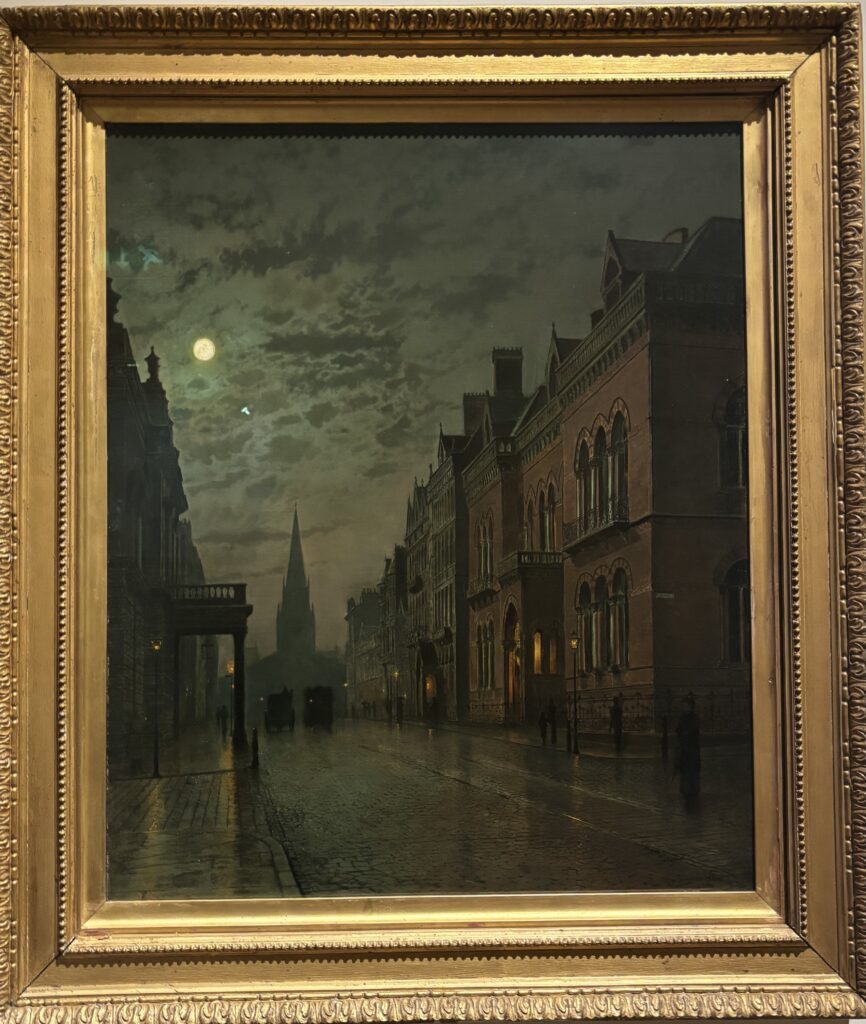
Image Credit: Olivia J Nivaud
As you look further into this scene, you will find almost no one walking about this solemnly lit night which, in a way, is quite inviting. It seems Grimshaw has painted this scene for the viewer alone. I stood in front of this painting for some time, wanting to walk along its undulating road, maybe hoping to catch one of those horse-driven carriages, which in my opinion should be brought back into society as they are much better than any double-decker bus.
The last thing I would like to point out in this scene is the church in the center of the frame. At the time, I will admit I had trouble seeing what type of building this was as it is very dark in comparison to the rest of the illuminated city. But after a second glance, the realization hit me: it is not by chance nor artistic style that Grimshaw made it so the road would lead you to the church. I have read that some critics believe this to be his proclamation of faith as he turned to Catholicism in the late 1860s. But then why is the church in the shadows? The rest of the city is highlighted despite parts where shadows should be and we know Grimshaw to have a peculiar artistic license, so this is done purposefully. The church spoke to me but not in a manner of unshakable faith, but of uncertainty in one’s faith. This does not go to speak ill of the Christian religion but more of a subtle comfort that despite one is struggling in their faith, the church will remain at the end of the road, waiting for your return.
Image Credit: Olivia J Nivaud
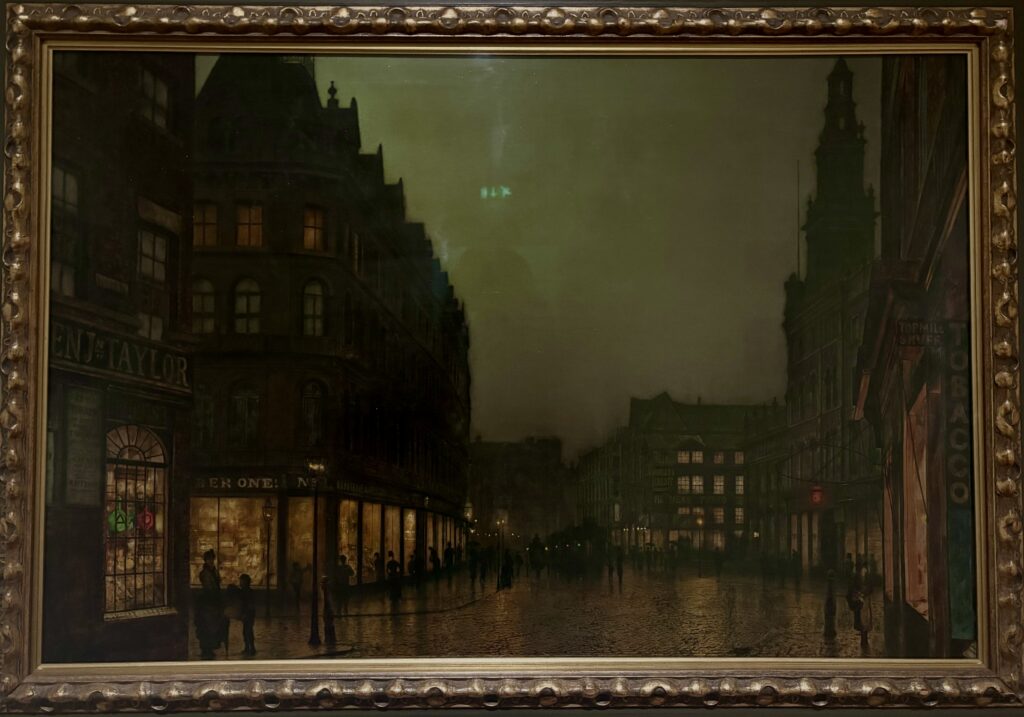
In the second painting, Boar Lane, Leeds by Lamplight (1881), Grimshaw shows the beauty of the wondrous treasures you can find within Leeds shops, displaying a sort of brilliance that can only be seen in this light. More people inhabit this painting, contrasting against the one previously mentioned. He captures such a lively and upbeat tone of life in Leeds as the gallery claimed he had rendered the streets surface almost “river-like, carrying onwards its flow of humanity.”
Having lived in Leeds for some time now, I have become accustomed to its constant rain and fog, which is not my ideal weather. Yet through Grimshaw’s lens of the city’s true beauty emerges: rain transforms the streets into a looking glass that carries a lingering resonance. I especially loved how he lit up almost every window, showing life even within the buildings. I have discovered that the specific oil traditional Victorian painters would use is linseed to create that enameled and glossy look, allowing the incandescence of the light to come to life.
One of my favorite activities to do in public spaces is people-watching and I carry this hobby into paintings as well. If you look to the left, just along the shop’s windows, you will find a woman and who I can only assume to be her son. There is a story in every corner of Grimshaw’s paintings and the beauty behind this, is that you get to tell that story.
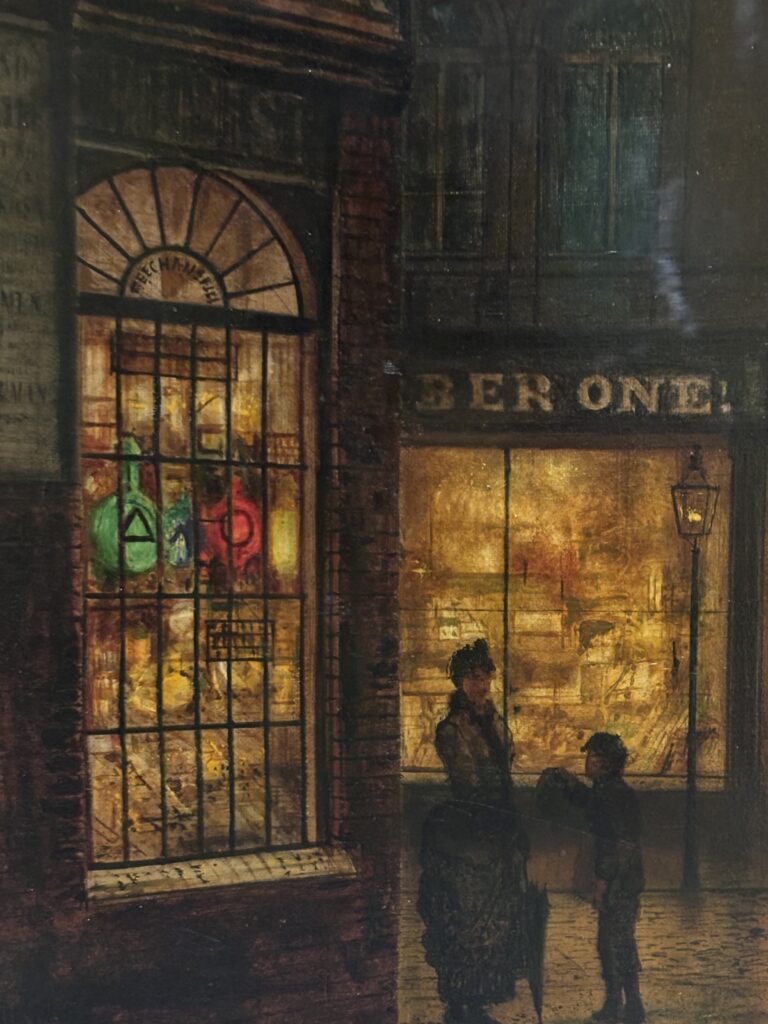
I think this story is about a boy who wants a toy or treat as he points out to his mother which store contains his desire. Perhaps the mother scolds him, saying he has enough at home; or maybe she indulges in his boyish youth and agrees. These characters do not possess faces, so it is quite hard to tell where this story leads. But with what I have come to learn about Grimshaw is that he is very purposeful in every stroke of his brush. There is only one spot of vivid green and that is the lantern in the shop window, hanging next to a red one. This immediately grabs your attention as the boy and the mother were the first people I noticed in this painting.
Overall, within this exhibit, you can see how Grimshaw had quite the artistic license for many of his paintings, making these Yorkshire scenes to be almost dream-like and illusive. After I had walked through the rest of the exhibit, I decided it would only be fair to Grimshaw if I were to, now, walk the very streets he painted. Maybe some would say that Leeds has lost the beauty that Grimshaw once painted; both paintings contrast greatly against the cluster of advertisement signs and heavy traffic that you would find today on these streets. But I find this to be more of an amusement and fascination if anything.
Despite the evolution of Leeds as an industrial city, it has never lost its charm that Grimshaw had captured. Charles Dickinson had once written that Leeds was “one of the dirtiest” and most “odious places” he had ever visited—this just proves two things that beauty for one: is in the eye of the beholder (cliche I know but it’s true). And two: even back then with the lens of Grimshaw, the beauty of Leeds was lost among some.
I think that Leeds is a culturally rich city with so many side-streets that you can slip through (yes that was a Smiths reference) and find hidden treasures of both people and art. I’ve enjoyed my time exploring the culture that Leeds has to offer, and I do not think the beauty is lost in its past; instead, it has transpired.
Words By: Olivia J Nivaud