
Let’s Be Malaysian with Aimaan
Aimaan Ariff recounts his tasteful time time in Malaysia while informing us on Malaysian culture.
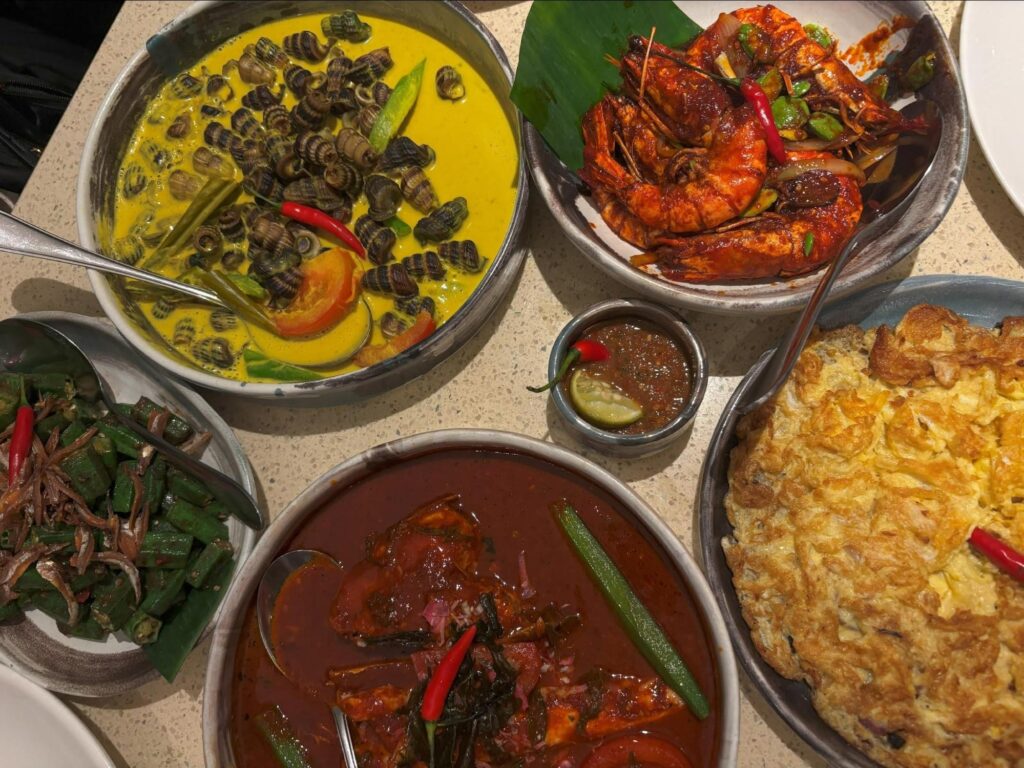
Figure shows siput sedut masak lemak, chilli prawn (top: from right) and okra with belacan, asam pedas ikan and omelette (bottom: from right) served at Cili Kampung Suria Kuala Lumpur Convention Centre. Image Credit: Aimaan
“What is nasi (sounds zi) l’ mac?”
“Umph, that’s not how it sounds. It is nasi lemak (phonetic).”
“Oh (awkward silence unfolded).”
I was standing amid a bunch of new shapes and faces just an hour after my 19-hour journey to Leeds. It was September 16th 2023, I experienced an unforgettable moment. As memories of my experiences and identity came to my mind, I thought to myself, “Have we promoted Malaysia enough to the world?”
Before we go into depth, let’s recount the societal impacts of colonisation from the 19th to 20th century when British greed was fed with mass migration of Chinese and Indians in Tanah Melayu or The Land of Malays. From large-scale production to exploitation of raw materials, immigrants were brought into an innocent land only to know they were ‘free labour’. They were exploited in their work in tin mines and plantation areas, hailing upon the ‘ambitious’ Industrial Revolution. Since Malaysia gained independence from Britain on August 31st, 1957, Chinese and Indian immigrants have been co-living with Malays and other ethnicities creating the multicultural and diverse Malaysia that we know today.
Food, fashion and lifestyle, every cultural aspect of living is a form of assimilation and acceptance towards one another’s differences. In Malaysia, public holidays are usually accompanied by a number of unique cultural and religious celebrations seen across ethnicities. This allows the Malaysian community to celebrate together alongside friends, family, neighbours and even strangers. That’s why Malaysia is denoted as having one of the highest number of public holidays! Famously, Malay celebrates Hari Raya Aidilfitri or Eid al-Fitri, whilst Chinese and Indian respectively dedicate some days for Chinese New Year and Deepavali.
A few months earlier, I spent my summer break in Malaysia with one enticing aim: satisfying food cravings! Every day, my sister and I would explore different parts of Ipoh, my hometown, hunting for exciting food. Two years of longing reached an indescribable nostalgic fulfilment, starting with our national dish: Nasi Lemak, a traditional Malay breakfast dish which was recognised by UNESCO as Intangible Cultural Heritage recently in December 2024.
Shining coconut rice with generous clusters of crunchy anchovies, peanuts, cucumber slices, boiled egg and bits of spicy sambal. Natives usually serve said national dish with roti canai and teh tarik. However, later in time, additional lauk e.g. rendang, chicken curry, sambal sotong and kerang masak lemak are included for a more flavourful brunch. Having said that, it was only number one in my food hunting series. Let’s unfold how colourful traditional Malaysian beverages present, especially with one of my favourites: Cendol particularly when it’s combined with the unique taste of durian.
Preserving cultural values in food is paramount, but assimilating international sensations is also important to provide variety. Malaysian hawker is known to be a trailblazer in creativity. The modification of the foreign dish to local preferences is one way it shows its innovation. In my experience, I got to taste the combination of aglio olio and chicken chop in a single plate.
Now, I am currently in Leeds re-embracing the sombre and excitement of the new season. In the midst of autumn leaving there is one thing I miss more: family dinner. No matter where, no matter how, no matter what, my family and I sitting at the dinner table enjoying food together is an endlessly rich cultural experience.